Legal & Origins
Where Does Kratom Grow Naturally? Native Range and Wild Habitat
Editorial Team Last updated
This page contains affiliate links. If you buy through them, the site may earn a commission at no extra cost to you.
Quick Answer
Kratom grows naturally in the wet tropical forests of Southeast Asia and Papuasia. Kew's Plants of the World Online lists its native range as Thailand, Cambodia, Peninsular Malaysia, Sumatra, Borneo, the Philippines and New Guinea, where it grows wild in humid lowland forests, along rivers and in seasonally flooded areas.
Key Facts
| Native regions | Indo-China, Malesia, Papuasia |
|---|---|
| Native countries/islands | Thailand, Cambodia, Malaysia, Sumatra, Borneo, Philippines, New Guinea |
| Also cultivated | Vietnam and elsewhere in the region |
| Wild habitat | Humid lowland forest, riverbanks, swampy ground |
| Type locality | Borneo (described by Korthals, 1839) |
| Conservation status | Least Concern (IUCN, as recorded by POWO) |
Where does kratom grow naturally (opens in a new tab)? Mitragyna speciosa is native to the wet tropical forests of Southeast Asia and New Guinea. According to Kew's Plants of the World Online, its native range covers Thailand and Cambodia in Indo-China; Peninsular Malaysia, Sumatra, Borneo and the Philippines in Malesia; and New Guinea in Papuasia. In these places it grows wild along rivers, in swampy lowlands and in humid secondary forest.
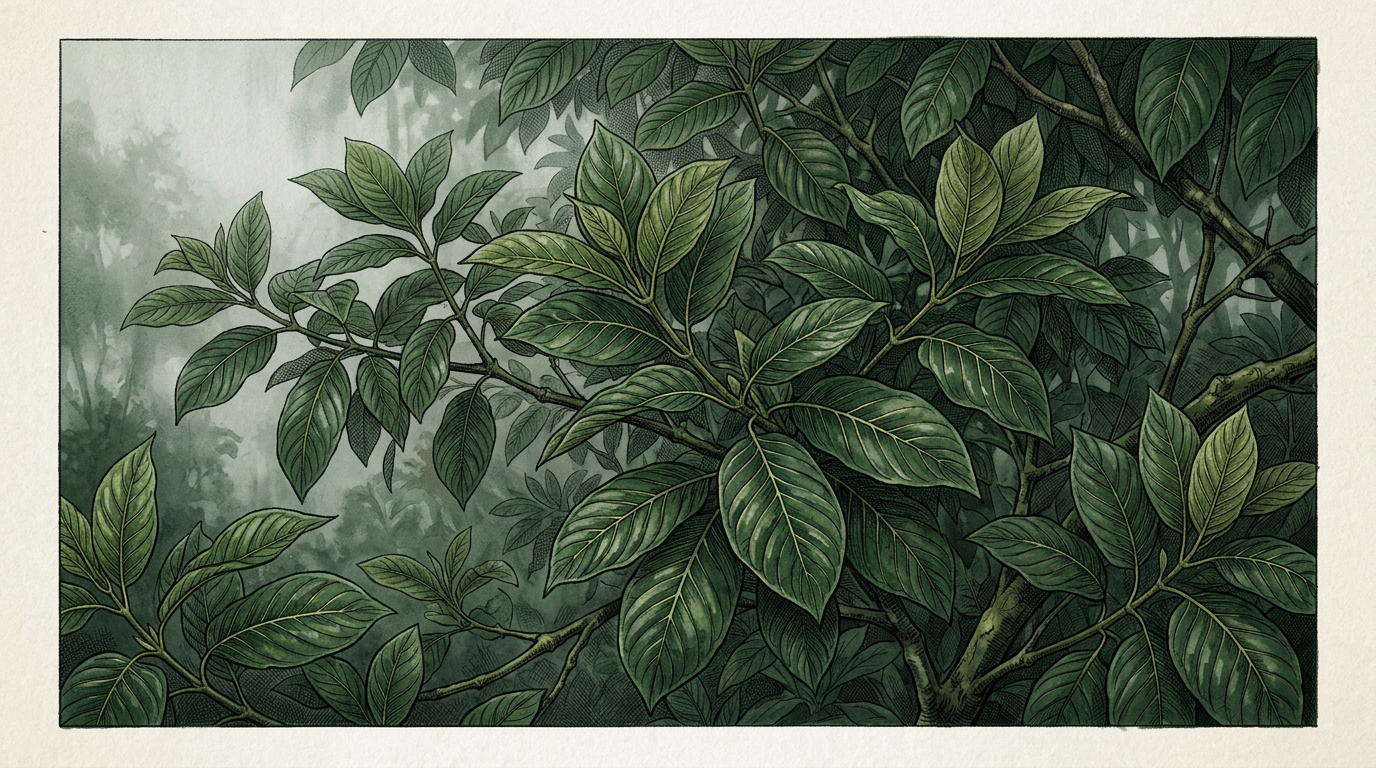
Where the kratom plant grows: region by region
Indo-China
In southern Thailand, kratom has a long history as a familiar village and forest tree. A 2022 survey published in Frontiers in Plant Science sampled naturally growing kratom populations across four regions of Thailand, showing the species grows across a range of local environments within the country. Cambodia also falls within the native range, and USDA GRIN Taxonomy notes cultivation in Vietnam.
Malesia
Malesia — the botanical region spanning Malaysia, Indonesia, the Philippines and nearby islands — is the heart of kratom's range. The species was first described by Pieter Korthals in 1839 from specimens collected in Borneo, near the Martapura area. Borneo and Sumatra remain strongly associated with kratom, and the Indonesian province of West Kalimantan on Borneo is today a major cultivation area. In the Philippines, where it is known as mambog, it occurs in low-altitude forests; see where kratom grows in the Philippines.
Papuasia
The range extends east to New Guinea, which includes both Papua New Guinea and the Indonesian provinces on the western half of the island.
Where does kratom grow wild? Its preferred habitat
Within its range, kratom favors specific conditions:
- Riverbanks and floodplains: Kratom is frequently found on alluvial soils along rivers, where moisture is constant and soils are fertile.
- Swampy and seasonally flooded ground: The tree tolerates wet soil better than many tropical species.
- Lowland forest: Most wild trees grow at low elevations with steady heat.
- Forest edges and secondary forest: Young trees often establish where some light reaches through the canopy.
The climate where kratom trees grow
Every part of the native range shares a hot, humid tropical climate with abundant rainfall and no frost. The Thai survey identified light intensity, relative humidity, soil moisture, soil pH and calcium as influential environmental factors among wild populations. The climate guide explores these conditions and how to imitate them.
Wild vs. cultivated kratom
Much of the kratom traded internationally today comes from cultivated trees rather than wild forest stands. In Indonesia, farmers in West Kalimantan grow kratom on riverbank land and smallholdings, and research has documented production on both mineral and peat soils in the Kapuas Hulu district. The guide on where they grow kratom commercially covers farming regions, and what countries grow kratom covers national producers and laws.
For readers interested in how sourcing practices differ between vendors, this guide on choosing a kratom vendor (opens in a new tab) explains what transparency about origin looks like.
Does kratom grow naturally anywhere else?
Kratom is not native outside tropical Asia and New Guinea. Trees growing in places such as Hawaii or Florida are cultivated, not wild. Related Mitragyna species do grow naturally in tropical Africa — for example, Mitragyna inermis and Mitragyna stipulosa — but they are different species and should not be confused with Mitragyna speciosa.
Conservation status
Kew's Plants of the World Online records kratom as Least Concern under the IUCN Red List. The species is widespread, regenerates readily in disturbed habitats, and is extensively cultivated.
What the native range means for home growers
Knowing where kratom grows naturally explains its needs in cultivation: constant warmth, high humidity, moist and fertile soil, and protection from cold. Home growers recreate a Bornean riverbank with humidifiers, rich potting soil and grow lights. The complete grow guide turns that into a step-by-step plan.
Frequently Asked Questions
Where does kratom grow in the world?
Kratom is native to Thailand, Cambodia, Malaysia, Indonesia (including Sumatra and Borneo), the Philippines and New Guinea. It is also cultivated elsewhere in the region, including Vietnam.
Does kratom grow wild in the United States?
No. Kratom is not native to the United States. Trees in Hawaii, Florida and other warm areas are cultivated plants.
What habitat do kratom trees grow in?
Wild kratom favors humid lowland forest, riverbanks, floodplains and seasonally swampy ground with fertile, moist soil.
Sources
- Mitragyna speciosa Korth. — Plants of the World Online (opens in a new tab) — Royal Botanic Gardens, Kew
- Mitragyna speciosa — GRIN-Global Taxonomy (Nomen 417532) (opens in a new tab) — USDA Agricultural Research Service, Germplasm Resources Information Network
- Variations in mitragynine content in the naturally growing Kratom (Mitragyna speciosa) population of Thailand — Leksungnoen et al. (2022) (opens in a new tab) — Frontiers in Plant Science 13:1028547
- Soil properties and heavy-metal levels in kratom production areas of Kapuas Hulu, West Kalimantan (opens in a new tab) — Indian Journal of Agricultural Research (ARCC Journals)
- Mambog — Mitragyna speciosa (Philippine Medicinal Plants) (opens in a new tab) — StuartXchange (Godofredo U. Stuart Jr., M.D.)
- A botanical, phytochemical and ethnomedicinal review of the genus Mitragyna Korth: Implications for products sold as kratom — Brown, Lund & Murch (2017) (opens in a new tab) — Journal of Ethnopharmacology 202:302–325 (PubMed record)
Written and reviewed by the Editorial Team. See editorial standards.
Related Guides
All guidesWhat Countries Grow Kratom? A Country-by-Country Guide
Indonesia, Thailand, Malaysia, the Philippines, Cambodia, Vietnam and Papua New Guinea, with Indonesia producing most exports.
Read guideWhere Do They Grow Kratom? Farming Regions and How Cultivation Works
Mostly on smallholder farms in Indonesia, especially West Kalimantan on Borneo, with smaller production elsewhere in Southeast Asia.
Read guideWhat Climate Does Kratom Grow In? Temperature, Rain and Humidity
A hot, humid, rainy tropical climate with no frost and little seasonal temperature change.
Read guide