Getting Started
How to Grow Kratom: The Complete Seed-to-Tree Guide
Editorial Team Last updated
This page contains affiliate links. If you buy through them, the site may earn a commission at no extra cost to you.
Quick Answer
Kratom (Mitragyna speciosa) grows best when kept above 65°F (18°C), at 60–80% relative humidity, in bright but filtered light and rich, well-draining, slightly acidic soil that stays evenly moist. Most home growers start from a rooted cutting or nursery plant, because seeds lose viability within weeks.
Key Facts
| Botanical name | Mitragyna speciosa (coffee family, Rubiaceae) |
|---|---|
| Ideal temperature | 70–90°F (21–32°C); damage risk below about 50°F (10°C) |
| Humidity | 60–80% relative humidity |
| Light | Bright, filtered light; 12–16 hours under grow lights |
| Soil pH | Roughly 5.5–6.5, rich and well-draining |
| Outdoor zones (US) | USDA zones 10–11 year-round; containers elsewhere |
| Time to a harvest-size tree | About 2–3 years from a cutting; longer from seed |
How do you grow kratom (opens in a new tab) successfully outside the tropics? The short version: recreate a warm Southeast Asian riverbank. Kratom is an evergreen tree in the coffee family that is native to wet tropical forests from southern Indo-China to New Guinea, and every part of a home grow — the pot, the soil, the light and the humidity — exists to imitate that environment. This pillar guide walks through the entire journey and links to a detailed guide for each stage.
Before buying anything, confirm that growing is permitted where you live. Kratom is legal to grow in most of the United States, but several states prohibit it outright. The guide on kratom growing laws in the US lists the current state-level picture.
Step 1: Choose a starting point
Home growers have three realistic options, and the choice shapes the first year more than any other decision.
- Seeds: Inexpensive but unreliable. Kratom seeds are tiny, lose viability quickly after harvest and often germinate at low rates. See how to grow kratom from seed for the full method.
- Rooted cuttings: The most popular choice. A cutting is a genetic copy of its parent and skips the most fragile seedling weeks. The guide to cloning kratom from cuttings explains how to root your own.
- Established nursery plants: The fastest path to a sizable tree, though the most expensive. Advice on vetting sellers is in the guide to buying kratom plants and seeds.
Step 2: Set up the growing environment
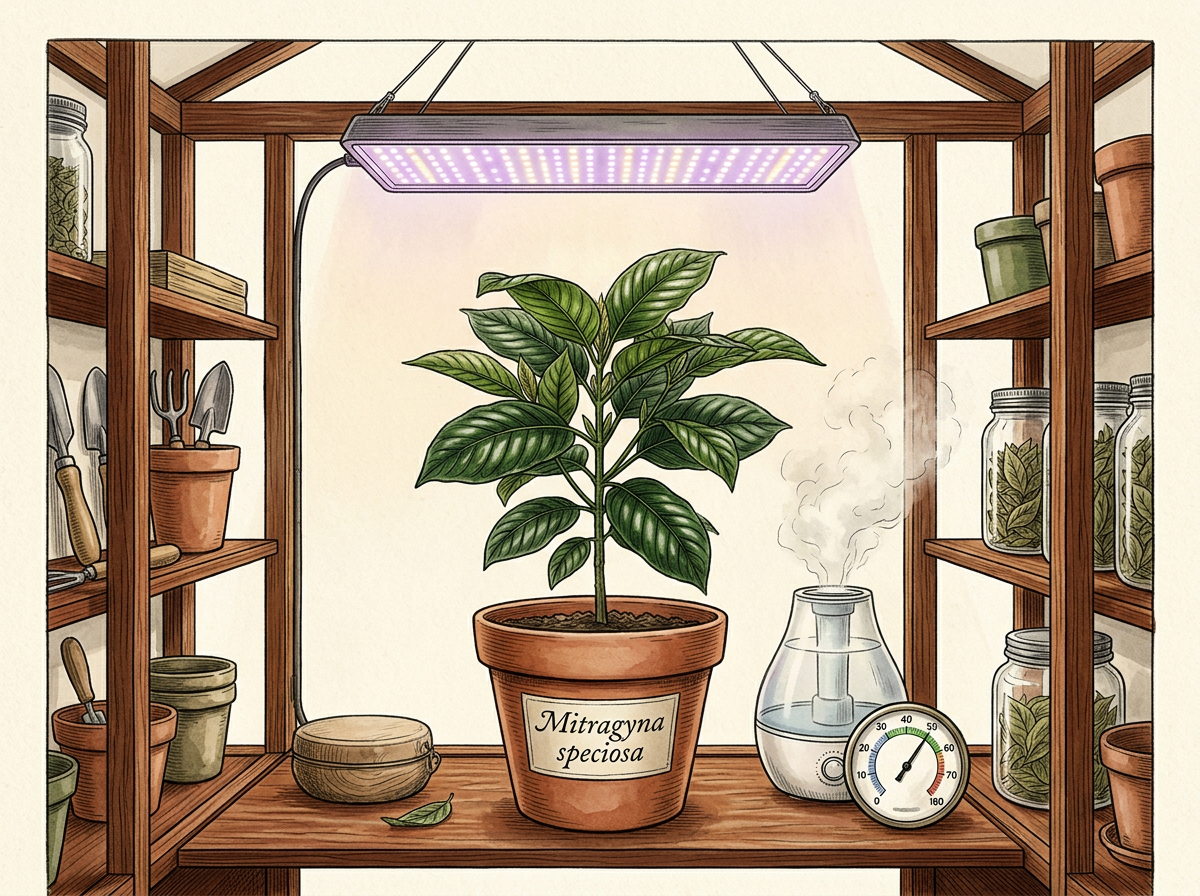
Most growers outside zones 10–11 keep kratom in containers so the tree can move indoors when nights cool down. An indoor setup needs four things: steady warmth, high humidity, bright light and airflow. The guide to growing kratom indoors covers grow tents, windows and room placement in depth.
Temperature
The tree prefers daytime temperatures between 70 and 90°F (21–32°C). Growth slows noticeably below 65°F, and many growers report leaf drop and cold damage when temperatures fall toward 50°F (10°C). Frost is usually fatal to young plants.
Humidity
Kratom leaves are large and thin, so they lose water fast in dry air. Aim for 60–80% relative humidity, especially for seedlings and fresh cuttings. A humidifier, a pebble tray or a grow tent makes this far easier to hold. The guide to watering and humidity for kratom explains how to balance moisture without inviting root rot.
Light
In the wild, young kratom trees often grow beneath taller canopy, and a University of Florida greenhouse trial found that shaded greenhouse plants produced larger leaves and more biomass than plants in open full sun. Indoors, a full-spectrum LED running 12–16 hours a day works well. The guide on how many hours of light kratom needs has timer schedules for each stage.
Step 3: Get the soil and pot right
Kratom wants soil that holds moisture yet never turns waterlogged. A practical mix combines a quality peat- or coir-based potting soil with perlite and composted bark, landing in a slightly acidic pH range of roughly 5.5–6.5. Always use a pot with drainage holes; fabric pots are popular because they let roots breathe. The guide to the best soil and pH for kratom includes tested recipes.
Step 4: Water, feed and protect
- Water evenly. Keep the top inch of soil lightly moist. Kratom is thirsty, but standing water starves roots of oxygen.
- Feed during active growth. Kratom is a leafy tree with a strong appetite for nitrogen. Research from the University of Florida found that higher fertilizer rates increased plant growth. The guide on how to fertilize kratom translates that into a home feeding schedule.
- Inspect leaves weekly. Spider mites, aphids and fungus gnats are the most common indoor problems. Early detection makes control simple; see kratom pests and diseases.
- Prepare for winter. Outside the tropics, cold is the biggest threat. Follow the overwintering kratom checklist before nights drop below 60°F.
Step 5: Shape the tree as it grows
A healthy kratom tree can grow several feet per year in good conditions and would eventually become a full-sized forest tree if left alone. Container growers control size by moving up gradually in pot size and pruning the leader to encourage a bushier shape. The guide to repotting and pruning kratom explains when to cut and how much to remove.
Step 6: Understand the timeline
Patience is the defining requirement. A rooted cutting typically needs two to three years of steady growth before it can spare leaves without slowing down, while seed-grown trees take longer. The full breakdown is in how long it takes to grow kratom, and a visual stage-by-stage walkthrough lives in the kratom growth stages guide.
Step 7: Harvest leaves sustainably
Once the tree is established, mature leaves can be picked by hand, taking only a portion of the canopy at a time so the tree keeps photosynthesizing. Drying and storing leaves is covered strictly as a gardening practice in when and how to harvest kratom leaves.
Common beginner mistakes
- Letting the soil dry out completely, which causes rapid leaf droop and drop.
- Overwatering a pot without drainage, which leads to root rot.
- Moving a plant from indoors to full outdoor sun without gradual hardening off.
- Ignoring night temperatures in spring and autumn.
- Repotting into a container that is far too large, which keeps the soil soggy.
Can I grow kratom where I live?
Climate is rarely the real barrier, because a container tree can live indoors for most of the year. The real limits are space, consistent humidity and local law. Readers in warmer regions should check the kratom grow zone guide to see whether the tree can stay outside year-round. Readers who want a frank assessment of the effort involved will find it in is it easy to grow kratom?.
With warmth, humidity, good soil and a lot of patience, a kratom plant can thrive far from Southeast Asia. Treat it as a long-term tropical tree project rather than a quick houseplant, and it will reward the effort with vigorous, glossy growth.
Frequently Asked Questions
Can I grow kratom at home in a cold climate?
Yes, as a container plant. Keep it indoors whenever nights fall below about 60°F (16°C), provide bright light and 60–80% humidity, and move it outside only during warm months after gradual hardening off.
Is it better to grow kratom from seed or from a cutting?
Most growers find rooted cuttings far easier. Kratom seeds lose viability quickly and germinate unevenly, while a rooted cutting skips the most fragile stage and grows true to its parent tree.
How fast does a kratom plant grow?
In warm, humid, bright conditions a young tree can add several feet per year. Growth slows sharply in cool or dry conditions, so indoor growth over winter is usually modest.
Sources
- Mitragyna speciosa Korth. — Plants of the World Online (opens in a new tab) — Royal Botanic Gardens, Kew
- Mitragyna speciosa — GRIN-Global Taxonomy (Nomen 417532) (opens in a new tab) — USDA Agricultural Research Service, Germplasm Resources Information Network
- Plant growth and phytoactive alkaloid synthesis in kratom [Mitragyna speciosa (Korth.)] in response to varying radiance — Zhang et al., PLoS ONE 17(4): e0259326 (2022) (opens in a new tab) — PLoS ONE
- Effects of Nutrient Fertility on Growth and Alkaloidal Content in Mitragyna speciosa (Kratom) — Zhang et al., Frontiers in Plant Science 11:597696 (2020) (opens in a new tab) — Frontiers in Plant Science (University of Florida researchers)
- USDA Plant Hardiness Zone Map (opens in a new tab) — USDA Agricultural Research Service
- Common grower experience (not a formal study) — Practices widely reported by hobby and nursery growers; treat as practical guidance rather than research findings
Written and reviewed by the Editorial Team. See editorial standards.
Related Guides
All guidesHow to Grow Kratom From Seed: Germination Step by Step
Use very fresh seed, surface-sow it on fine moist mix, and keep it warm, humid and lit under a dome.
Read guideHow to Clone Kratom From Cuttings: Step-by-Step Propagation Guide
Take a healthy stem cutting, trim the leaves, optionally dip in rooting hormone, and keep it warm and very humid with about 14 hours of light until it roots.
Read guideHow to Grow Kratom Indoors: Light, Humidity and Space Setup
Yes — with a full-spectrum LED, a humidifier, steady 70–85°F warmth and gentle airflow.
Read guide