Care
Watering and Humidity for Kratom: How Wet, How Often, How Humid
Editorial Team Last updated
This page contains affiliate links. If you buy through them, the site may earn a commission at no extra cost to you.
Quick Answer
Kratom likes evenly moist soil and humid air. Water thoroughly when the top inch of soil begins to dry, let excess drain away, and never leave the pot standing in water. For seedlings, cuttings and young plants, aim for roughly 60–80% relative humidity; established trees tolerate somewhat lower humidity, but 50% or more keeps leaves in better shape. Humidifiers, humidity trays, grouping plants and small grow tents all help indoors.
Key Facts
| Soil moisture | Evenly moist, never soggy |
|---|---|
| When to water | When the top ~1 inch starts to dry |
| Humidity (young plants) | About 60–80% |
| Humidity (established) | 50%+ preferred |
| Cuttings | Near-saturated humidity under a dome |
| Measure with | Digital thermometer-hygrometer |
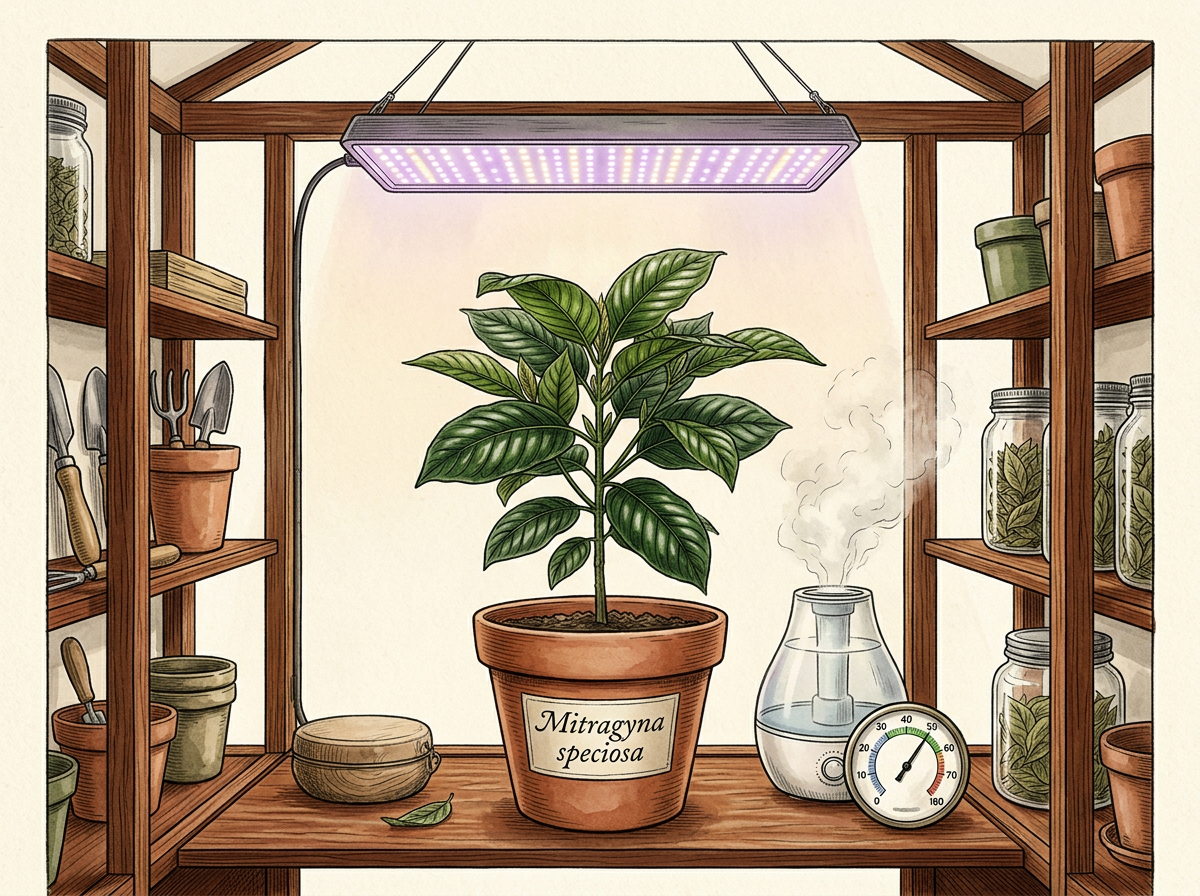
Kratom humidity requirements (opens in a new tab) and watering needs go hand in hand. Mitragyna speciosa grows wild along tropical rivers and in swampy lowlands, where the soil rarely dries out and the air is constantly humid. Indoor homes, especially in winter, are much drier. Getting water and humidity right is often the difference between a lush tree and one with brown, curling leaves. This guide explains how often to water, how humid to keep the air, and how to fix common problems.
Why kratom needs moisture
Kratom's large leaves lose a lot of water through transpiration. In its native habitat, constant soil moisture and humid air balance that loss. A 2022 survey of naturally growing kratom in Thailand identified relative humidity and soil moisture among the environmental factors that varied between populations, underlining how closely the tree is tied to moist conditions.
How often to water kratom
There is no fixed schedule; watering depends on pot size, mix, temperature, light and season. A reliable approach:
- Check the soil. Push a finger about an inch into the mix. If it feels just barely dry, it is time to water.
- Water thoroughly. Add water slowly until it runs from the drainage holes, so the whole root ball is moistened.
- Drain fully. Empty saucers after 15–30 minutes. Standing water starves roots of oxygen.
- Adjust by season. Plants in warm, bright conditions may need water every few days; in cool winter conditions, much less often.
Lifting the pot is another useful check: a freshly watered pot feels heavy, and a pot ready for water feels noticeably lighter.
Water quality
Room-temperature water avoids chilling roots. Rainwater or filtered water is helpful where tap water is very hard, since minerals can build up in containers over time. Flushing the pot with plain water occasionally helps clear salt buildup from fertilizers.
Kratom humidity levels by stage
- Germinating seeds: Near 100% under a dome, with brief daily venting
- Cuttings: Near-saturated air under a dome or bag tent until rooted; see cloning
- Seedlings and young plants: About 60–80%
- Established trees: 50% or more preferred; they tolerate somewhat drier air once mature
How to raise humidity indoors
- Humidifier: The most effective option for a room or plant corner. Clean it regularly to prevent mineral dust and microbial growth.
- Humidity tray: A shallow tray of pebbles and water under the pot raises humidity slightly around the plant. A plant humidity tray (opens in a new tab) is an easy, low-cost addition.
- Grouping plants: Plants clustered together create a more humid microclimate.
- Grow tent or cabinet: Gives the most control for small plants.
- Away from vents: Heating and cooling vents dry leaves quickly.
Misting leaves gives only a brief increase in humidity and can encourage fungal problems if leaves stay wet in poor airflow, so it is not a substitute for a humidifier.
Measure, don't guess
A digital thermometer-hygrometer placed near the plant shows actual conditions. Many homes drop to 30% humidity or lower in winter, far below what kratom prefers. Models with min/max memory reveal overnight swings. Temperature matters too: kratom grows best around 75–90°F (24–32°C).
Overwatering vs. underwatering
Signs of overwatering
- Yellowing lower leaves and soft, drooping growth
- Soil that stays wet for many days
- A sour smell or dark, mushy roots
- Fungus gnats around the soil surface
Signs of underwatering or low humidity
- Brown, crispy leaf edges and tips
- Leaves curling or drooping, then perking up after watering
- Soil pulling away from the pot edge
- Leaf drop during dry winter months
If roots have rotted, trim away dark, mushy roots and repot into fresh, airy mix; see the soil guide and repotting.
Watering outdoor and seasonal plants
Container plants outdoors in summer may need daily watering in heat and wind. When nights cool, bring them indoors before temperatures fall much below 50°F (10°C), and expect water needs to drop. See overwintering kratom.
Humidity, airflow and pests
Dry air favors spider mites, a common indoor pest that UC IPM notes thrives in dusty, dry conditions. Keeping humidity up helps discourage them. At the same time, gentle airflow from a small fan reduces fungal problems in very humid setups. See kratom pests and diseases.
For the full care picture, read how to grow kratom indoors.
Frequently Asked Questions
What humidity does kratom need?
About 60–80% for seedlings, cuttings and young plants. Established trees tolerate lower humidity, but 50% or more keeps leaves healthier.
How often should I water kratom?
Water thoroughly when the top inch of soil begins to dry, then let excess drain. Frequency depends on pot size, temperature, light and season.
Why are my kratom leaves turning brown at the edges?
Brown, crispy edges usually point to low humidity or underwatering. Check humidity with a hygrometer and keep soil evenly moist.
Sources
- Variations in mitragynine content in the naturally growing Kratom (Mitragyna speciosa) population of Thailand — Leksungnoen et al. (2022) (opens in a new tab) — Frontiers in Plant Science 13:1028547
- UC IPM Pest Notes (Spider Mites 7405, Aphids 7404, Scales 7408) (opens in a new tab) — University of California Statewide Integrated Pest Management Program
- Extension Gardener Handbook (opens in a new tab) — NC State Extension
- Mitragyna speciosa Korth. — Plants of the World Online (opens in a new tab) — Royal Botanic Gardens, Kew
- Common grower experience (not a formal study) — Practices widely reported by hobby and nursery growers; treat as practical guidance rather than research findings
Written and reviewed by the Editorial Team. See editorial standards.
Related Guides
All guidesBest Soil and pH for Kratom: Potting Mixes That Keep Roots Happy
A rich, well-draining potting mix with plenty of organic matter and perlite, kept slightly acidic at roughly pH 5.5–6.5.
Read guideHow to Grow Kratom Indoors: Light, Humidity and Space Setup
Yes — with a full-spectrum LED, a humidifier, steady 70–85°F warmth and gentle airflow.
Read guideKratom Pests and Diseases: Identification, Prevention and Treatment
Spider mites, aphids, scale and fungus gnats are the usual pests; root rot from overwatering is the most common disease. Inspect often and treat early.
Read guide