Propagation
How to Grow Kratom From Seed: Germination Step by Step
Editorial Team Last updated
This page contains affiliate links. If you buy through them, the site may earn a commission at no extra cost to you.
Quick Answer
To grow kratom from seed, start with the freshest seed available, scatter it on the surface of a fine, sterile, moist seed mix without covering it, and keep it at 75–85°F (24–29°C) under a humidity dome with gentle light. Expect low, uneven germination over one to four weeks.
Key Facts
| Seed viability | Short; freshness matters more than anything |
|---|---|
| Sowing depth | Surface-sown, not buried |
| Germination temperature | 75–85°F (24–29°C) |
| Humidity | Near 100% under a dome, vented daily |
| Germination time | About 1–4 weeks |
| Typical success rate | Low and variable (common grower experience) |
Learning how to grow kratom from seed (opens in a new tab) is a lesson in patience and precision. Kratom seeds are tiny — closer to dust than to a bean — and are widely reported to lose viability within weeks of harvest. Researchers studying kratom propagation describe low seed viability and poor germination as the main reasons commercial growers rely on cuttings instead. Still, seed-starting is rewarding and inexpensive, and with the right setup a handful of seedlings is a realistic goal.
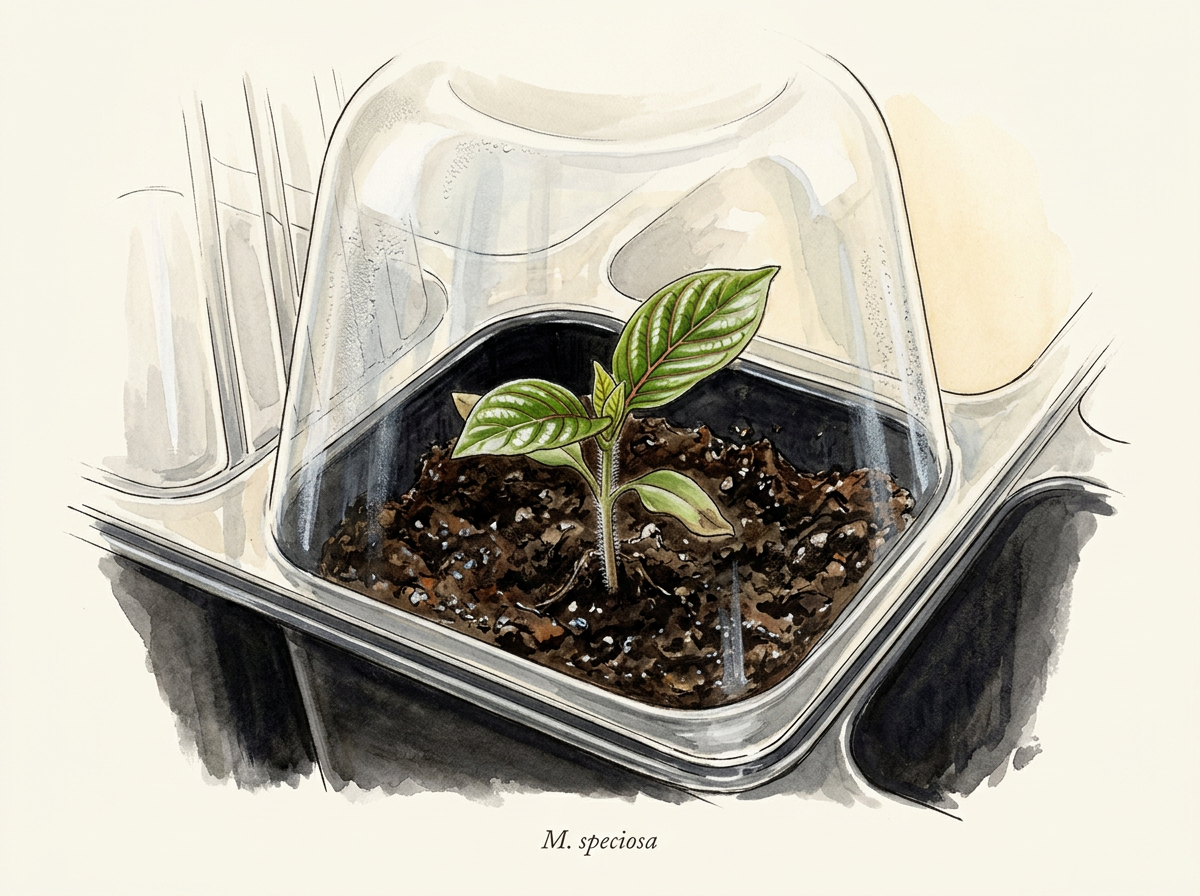
Before you start: sourcing fresh seed
Seed freshness is the single biggest factor in success. Kratom seeds develop inside round seed heads on mature trees, and growers commonly report that germination drops sharply as seeds age. When buying, look for a stated harvest date, ask how the seeds were stored, and be wary of sellers offering large quantities year-round at low prices. The guide to buying kratom plants and seeds covers how to vet private sellers.
What you need
- A shallow seed tray or small pots with drainage holes
- A fine, sterile seed-starting mix (peat or coir with fine perlite)
- A clear humidity dome or a sealed clear container
- A seedling heat mat with a thermostat, if your room runs cool
- A spray bottle that produces a fine mist
- Gentle light: a bright window without direct sun, or an LED placed at a distance
Step-by-step germination
- Prepare the mix. Moisten the seed mix until it feels like a wrung-out sponge, then fill the tray and lightly level the surface without packing it down.
- Sow on the surface. Sprinkle seeds thinly across the surface. Do not cover them. Kratom seeds are so small that burying them prevents emergence, and growers widely report that light helps trigger germination.
- Mist gently. Mist the surface so the seeds settle into contact with the mix. Avoid pouring water, which can wash seeds into clumps.
- Cover and warm. Place the dome on top and set the tray on a heat mat at roughly 75–85°F (24–29°C).
- Provide gentle light. Bright, indirect light or an LED on a 14–16 hour timer works well. Keep strong lights far enough away that the dome does not overheat.
- Vent daily. Lift the dome for a few minutes once or twice a day to refresh the air and reduce mold risk. Re-mist if the surface looks dry.
- Wait and watch. Sprouts usually appear in one to four weeks as tiny green specks with two round seed leaves.
Caring for new seedlings
Kratom seedlings grow slowly at first and are very delicate. Keep the dome on but vent it more each day once the first true leaves appear. True leaves look like miniature versions of adult kratom leaves, with a pointed oval shape and visible veins.
Watering
Bottom-water by setting the tray in a shallow dish of water for a few minutes, or mist carefully. Never let the surface dry out completely, but avoid soggy conditions that encourage damping-off, a fungal disease that collapses seedlings at the soil line.
Light
As seedlings develop, they can handle more light. The University of Minnesota Extension notes that seedlings generally need 16–18 hours of light per day under artificial lighting, with lights kept relatively close. Watch for stretching, which means the light is too weak or too far away. The light hours guide has stage-specific schedules.
Feeding
Hold off on fertilizer until seedlings have at least two sets of true leaves. Then use a very dilute fertilizer, around a quarter of label strength, every couple of weeks.
Transplanting seedlings
Wait until seedlings have three or four sets of true leaves and a little root mass before transplanting. Move each seedling into a small pot of light, airy potting mix, handling it by a leaf rather than the fragile stem. Keep transplants under a dome or in a humid space for another week or two while they adjust. From there, standard young-tree care applies; see the complete grow guide.
Troubleshooting
- Nothing sprouts after four weeks: The seed was most likely too old. Germination failure is very common with kratom and is not usually a sign of a technique problem.
- White fuzz on the surface: Mold. Increase venting, reduce misting, and consider a light dusting of cinnamon, a common grower remedy.
- Seedlings collapse at the base: Damping-off. Use sterile mix and clean trays for the next attempt, and avoid overwatering.
- Long, thin, pale seedlings: Not enough light. Move the light closer or extend the photoperiod.
Seed vs. cutting: which is right for you?
Seeds are cheap and produce genetically unique plants, but success rates are low and growth is slow. Cuttings root more reliably and skip the fragile seedling stage. A 2025 Frontiers in Plant Science study reported rooting rates of 85–92% for kratom cuttings in aeroponic systems, far above what most growers see from seed. Many growers start one seedling batch for the experience and root cuttings alongside. See how to clone kratom from cuttings and the growing timeline for comparison.
Frequently Asked Questions
Should kratom seeds be buried?
No. Kratom seeds are extremely small and should be surface-sown on fine, moist mix. Burying them typically prevents germination.
Why didn't my kratom seeds germinate?
Old seed is the most common cause, because kratom seed loses viability quickly. Drying out, cold temperatures and mold are the next most common causes.
How long can kratom seeds be stored?
Fresh seed is strongly preferred. Growers widely report that germination falls sharply within weeks of harvest, so seeds should be sown as soon as possible after purchase.
Sources
- Aeroponics enables consistent cutting propagation of kratom (Mitragyna speciosa): impacts of photoperiod, cultivar, and rooting hormone (2025) (opens in a new tab) — Frontiers in Plant Science
- Extension Gardener Handbook, Chapter 13: Propagation (opens in a new tab) — NC State Extension
- Lighting for indoor plants (opens in a new tab) — University of Minnesota Extension
- Mitragyna speciosa Korth. — Plants of the World Online (opens in a new tab) — Royal Botanic Gardens, Kew
- Common grower experience (not a formal study) — Practices widely reported by hobby and nursery growers; treat as practical guidance rather than research findings
Written and reviewed by the Editorial Team. See editorial standards.
Related Guides
All guidesHow to Clone Kratom From Cuttings: Step-by-Step Propagation Guide
Take a healthy stem cutting, trim the leaves, optionally dip in rooting hormone, and keep it warm and very humid with about 14 hours of light until it roots.
Read guideBuying Kratom Plants and Seeds: Nurseries, Private Growers and What to Check
Buy a rooted plant or cutting from a nursery that ships legally to your state; seeds are cheap but often fail because they lose viability fast.
Read guideKratom Growth Stages in Pictures: From Seed to Mature Tree
Six visual stages: germination, seedling, rooted cutting, young tree, mature tree and leaf harvest.
Read guide