Care
How Many Hours of Light Does Kratom Need? Light Schedules by Stage
Editorial Team Last updated
This page contains affiliate links. If you buy through them, the site may earn a commission at no extra cost to you.
Quick Answer
Kratom grows best with roughly 12–16 hours of light per day when grown indoors under lights. Seedlings and cuttings benefit from the longer end of that range, and a 2025 study found kratom cuttings rooted better under a 14-hour photoperiod than a 10-hour one. Outdoors near the equator, kratom receives about 12 hours of daylight year-round, so it does not need extremely long days — it needs consistent, bright light and a regular dark period.
Key Facts
| Indoor daily light | 12–16 hours |
|---|---|
| Cuttings (rooting) | ~14 hours outperformed 10 hours in a 2025 study |
| Seedlings | 14–16 hours (general extension guidance for seedlings: 16–18) |
| Established trees | 12–14 hours |
| Native day length | ~12 hours year-round near the equator |
| Light distance (LED) | Often 12–24 in above foliage; follow the fixture's guidance |
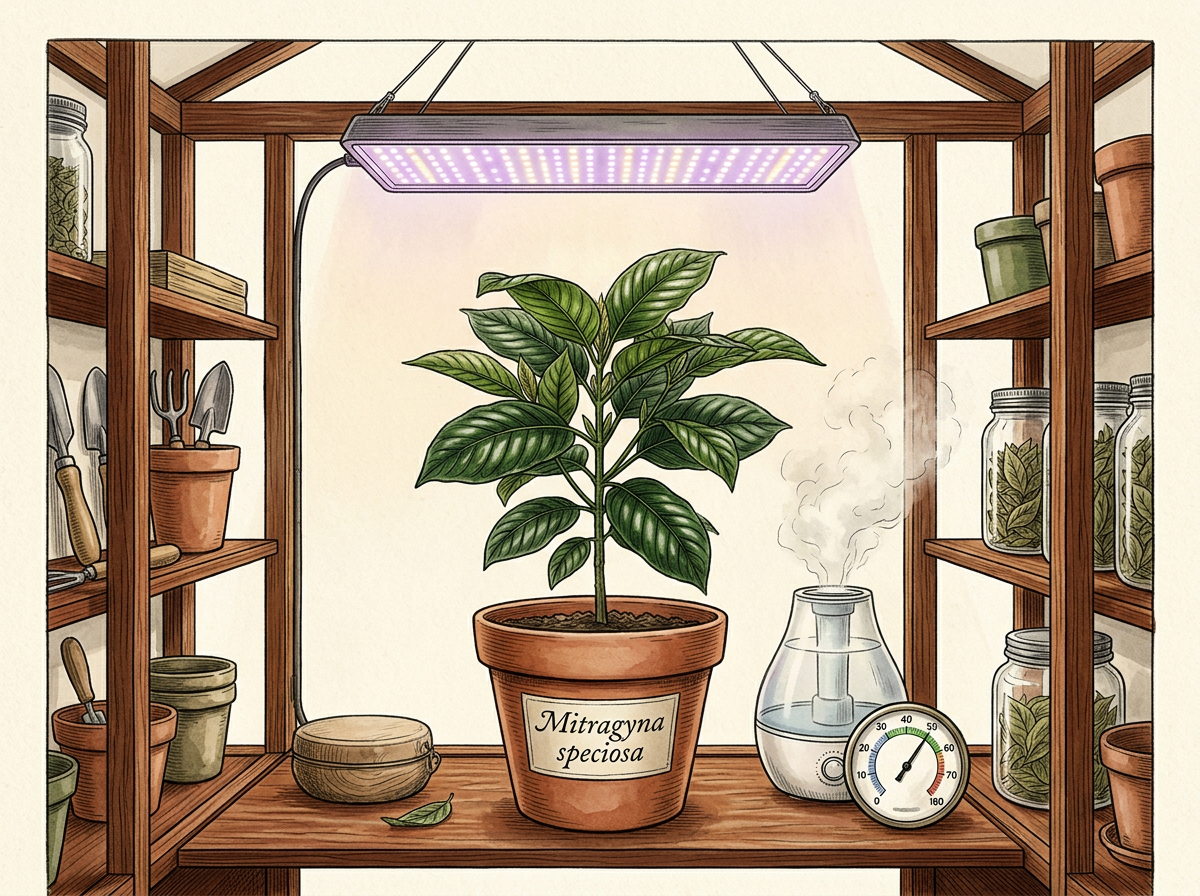
How many hours of light does kratom need? Most people searching grow kratom hours (opens in a new tab) want a simple schedule, and the practical answer is 12–16 hours of light per day for plants grown indoors, followed by an uninterrupted dark period. Kratom (Mitragyna speciosa) evolved near the equator, where day length stays close to 12 hours all year, but under artificial light, slightly longer days help make up for the lower intensity of most indoor setups. This guide gives schedules for each stage, the research behind them, and how to automate the routine.
Why light hours matter
Plants convert light into the sugars they use to grow. The total amount of light a plant receives each day is a combination of intensity (how bright the light is) and duration (how many hours it is on). Indoor grow lights are usually far less intense than tropical sun, so extending the hours is a simple way to give kratom more total light. Research has shown that light conditions measurably affect kratom; a 2022 PLoS ONE study, for example, compared kratom growth under different levels of radiance.
Recommended light schedules by stage
Seeds and germination
Kratom seeds are tiny and are usually surface-sown, so light reaches them directly. Keep a germination tray under gentle light for about 14–16 hours a day, with high humidity and warmth. The seed guide explains the full process.
Seedlings
Young seedlings stretch (become tall and weak) if light is too dim. University of Minnesota Extension suggests 16–18 hours of light for seedlings in general, with lights kept fairly close. For kratom seedlings, 14–16 hours is a widely used and practical range.
Cuttings
A 2025 study in Frontiers in Plant Science tested kratom cuttings in aeroponic systems and found that a 14-hour photoperiod produced better rooting than a 10-hour photoperiod, with rooting rates of 85–92% in the aeroponic system. For home cloning, 14 hours under moderate light is a good target. See how to clone kratom from cuttings for the full method.
Young and established trees
Once a plant is growing steadily, 12–14 hours of strong light is usually enough. That matches University of Minnesota guidance for foliage plants (12–14 hours) and stays close to kratom's natural equatorial day. Running lights much longer gives diminishing returns and raises electricity costs.
Quick schedule chart
- Germination: 14–16 hours on / 8–10 off
- Seedlings: 14–16 hours on / 8–10 off
- Rooting cuttings: about 14 hours on / 10 off
- Young trees: 12–14 hours on / 10–12 off
- Mature indoor trees: 12–14 hours on / 10–12 off
Do kratom plants need darkness?
Yes. A regular dark period is part of a healthy daily rhythm for most plants, and kratom grows naturally with about 12 hours of night. Running lights 24 hours a day is not recommended. Keep the schedule consistent: the same on and off times every day are better than an irregular routine.
Automate it with a timer
The easiest way to keep a consistent schedule is a plug-in timer. A basic mechanical or digital outlet timer switches grow lights on and off at set times, and many LED fixtures have built-in timers. Look for a timer rated for the fixture's wattage, with grounded outlets and a simple way to set on/off periods. Many growers look for a grow light timer (opens in a new tab) that can handle more than one fixture.
Light intensity and distance
Hours are only half of the equation. A dim light left on for 16 hours may still provide less useful light than a bright one on for 12. Practical points:
- Use a full-spectrum LED. Modern LEDs are efficient and run cooler than older lighting. Compare options for a full spectrum LED grow light (opens in a new tab) sized for the plant.
- Mind the distance. University of Minnesota Extension notes lights are often placed 12–24 inches above foliage; follow the manufacturer's guidance.
- Watch the leaves. Pale or bleached patches can mean light is too intense or too close; long gaps between leaves and leaning toward the light suggest too little.
- Raise lights as the plant grows. Keep the distance consistent as the canopy rises.
Window light and outdoor light
A bright south-facing window (in the Northern Hemisphere) can support kratom in summer, but winter days at higher latitudes are short and weak. Many growers supplement window light with a grow light in the morning and evening to reach 12–14 total hours. Outdoors, kratom enjoys bright light, but young plants should be introduced to full sun gradually to avoid leaf scorch. The indoor growing guide covers combined setups.
Signs your schedule needs adjusting
- Stretched, leggy stems: too little light (hours or intensity)
- Small new leaves: often too little light
- Bleached or crispy patches: light too close or too strong
- Slow growth in winter: light, temperature or both may be too low; see overwintering kratom
Light works together with warmth, humidity and nutrition. If growth is slow despite a good light schedule, review watering and humidity and the overall grow guide.
Frequently Asked Questions
Can kratom have 24 hours of light?
Continuous light is not recommended. Kratom grows naturally with about 12 hours of night, and a consistent daily dark period is better for the plant.
How many hours of light do kratom cuttings need?
About 14 hours. A 2025 study found kratom cuttings rooted better under a 14-hour photoperiod than under a 10-hour photoperiod.
Is a window enough light for kratom?
A bright window can work in summer, but winter light is usually too short and weak at higher latitudes. Most indoor growers add a grow light to reach 12–14 hours.
Sources
- Aeroponics enables consistent cutting propagation of kratom (Mitragyna speciosa): impacts of photoperiod, cultivar, and rooting hormone (2025) (opens in a new tab) — Frontiers in Plant Science
- Plant growth and phytoactive alkaloid synthesis in kratom [Mitragyna speciosa (Korth.)] in response to varying radiance — Zhang et al., PLoS ONE 17(4): e0259326 (2022) (opens in a new tab) — PLoS ONE
- Lighting for indoor plants (opens in a new tab) — University of Minnesota Extension
- Mitragyna speciosa Korth. — Plants of the World Online (opens in a new tab) — Royal Botanic Gardens, Kew
- Common grower experience (not a formal study) — Practices widely reported by hobby and nursery growers; treat as practical guidance rather than research findings
Written and reviewed by the Editorial Team. See editorial standards.
Related Guides
All guidesHow to Grow Kratom Indoors: Light, Humidity and Space Setup
Yes — with a full-spectrum LED, a humidifier, steady 70–85°F warmth and gentle airflow.
Read guideHow to Clone Kratom From Cuttings: Step-by-Step Propagation Guide
Take a healthy stem cutting, trim the leaves, optionally dip in rooting hormone, and keep it warm and very humid with about 14 hours of light until it roots.
Read guideHow to Grow Kratom From Seed: Germination Step by Step
Use very fresh seed, surface-sow it on fine moist mix, and keep it warm, humid and lit under a dome.
Read guide