Getting Started
Grow Kratom at Home: A Practical Setup for Apartments and Houses
Editorial Team Last updated
This page contains affiliate links. If you buy through them, the site may earn a commission at no extra cost to you.
Quick Answer
To grow kratom at home, choose a bright, warm spot away from drafts, add a humidifier to hold 60–80% humidity, supplement window light with a full-spectrum LED, and keep the tree in a draining pot of rich soil. A simple weekly routine of checking soil, leaves and humidity handles most care.
Key Facts
| Best spot | Bright window, warm interior wall, away from vents |
|---|---|
| Humidity | 60–80% (humidifier recommended) |
| Weekly time | About 15–30 minutes |
| Starter budget | Modest: pot, soil, humidifier, LED, hygrometer |
| Pets | Keep plants out of reach of curious animals |
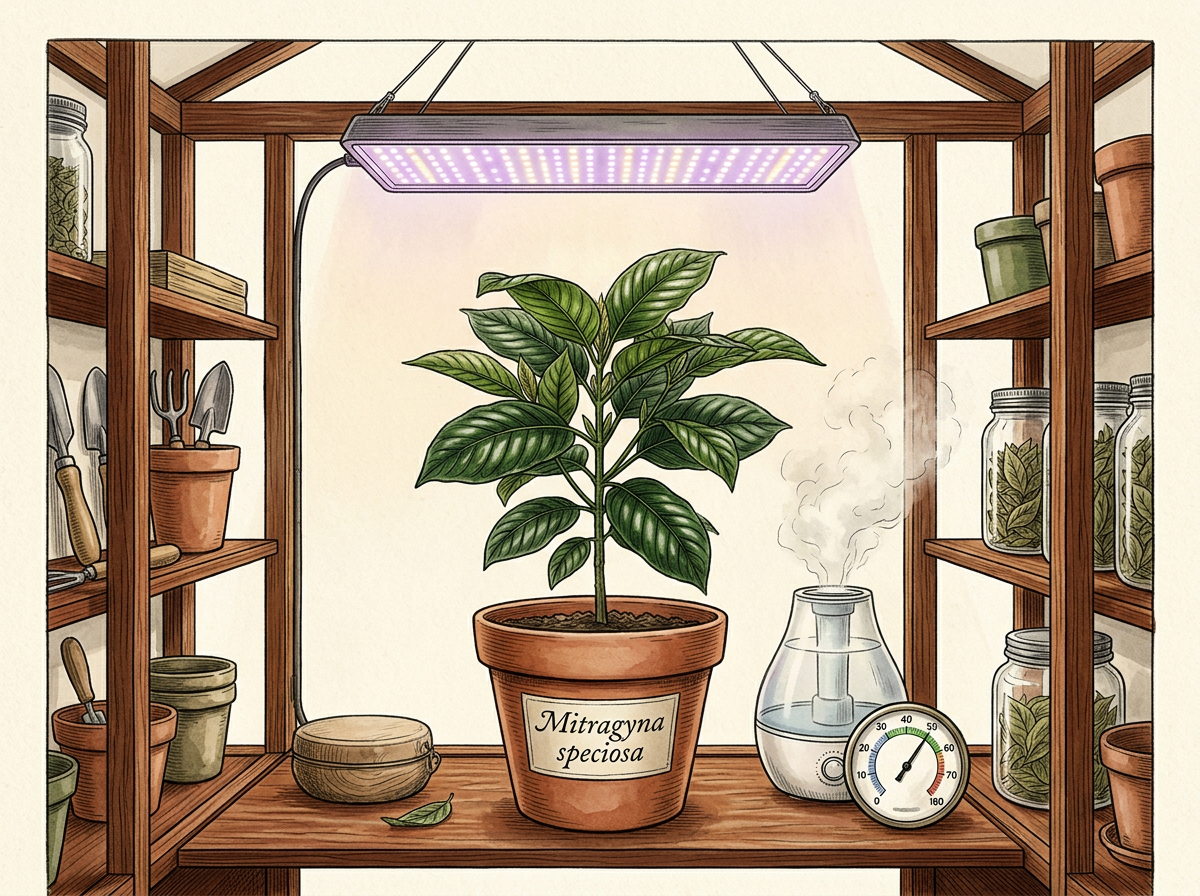
Plenty of people grow kratom at home (opens in a new tab) in apartments, townhouses and suburban houses far from the tropics. Success does not require a greenhouse — it requires a well-chosen spot, a few inexpensive tools, and a routine that keeps conditions steady. This guide focuses on the practical side of fitting a tropical tree into everyday life.
Before buying a plant, confirm that growing is allowed in your state and city. The legal guide summarizes the current US landscape.
Step 1: Find the right spot
Walk through your home and look for a location that ticks most of these boxes:
- Bright light: a south- or west-facing window is ideal; east-facing works with a grow light.
- Stable warmth: away from exterior doors, drafty windows, and heating or air-conditioning vents.
- Room to grow: at least a few feet of vertical space, with more needed in later years.
- Easy watering: a floor that tolerates the occasional spill, or a large saucer.
- Power outlet nearby: for a grow light, humidifier and fan.
Bathrooms with a bright window are surprisingly good homes for young plants because showers raise humidity. Living rooms and home offices also work well with a humidifier.
Step 2: Solve the humidity problem
Dry indoor air is the most common reason home-grown kratom struggles. Heated homes in winter often drop below 30% humidity, while kratom prefers 60–80%. Large, thin leaves dry out quickly, curl at the edges and become magnets for spider mites.
- Place a cool-mist humidifier within a few feet of the plant.
- Put a digital hygrometer at leaf height to track readings.
- Refill the humidifier daily and clean it regularly to prevent mineral buildup and mildew.
- In very dry homes, consider a small grow tent, which holds humidity far more efficiently than an open room.
The watering and humidity guide explains how humidity and watering frequency work together.
Step 3: Add light where needed
Even a bright window delivers far less light than open tropical sky, and winter days at northern latitudes are short. A full-spectrum LED on a timer keeps growth steady. For small spaces, clip-on or bar-style LEDs work well; for larger trees, a hanging panel covers more canopy. The indoor growing guide covers placement and distance in detail.
Step 4: Set up the pot and soil
Start a young plant in a 1-gallon pot with drainage holes, filled with rich, airy, slightly acidic potting mix. Fabric pots reduce overwatering risk, which is helpful for busy households. Keep a saucer underneath to protect floors, but empty it after watering.
Step 5: Build a weekly routine
Consistency matters more than perfection. A simple routine:
- Every day or two: glance at the leaves, check the hygrometer, refill the humidifier.
- Twice a week: check soil moisture with a finger; water when the top inch is dry.
- Weekly: inspect leaf undersides for pests, rotate the pot a quarter turn for even growth, wipe dust from leaves.
- Every 2–4 weeks (spring–summer): feed with a diluted fertilizer. See how to fertilize kratom.
- Seasonally: repot or prune as needed, and adjust for winter.
Living with a tropical tree
Travel
Kratom does not tolerate drying out. For trips longer than a few days, use self-watering spikes, a wicking setup, or ask someone to water. Grouping plants and lowering light hours slightly can reduce water use while away.
Pets and children
Keep plants out of reach of pets and young children, as with any houseplant not intended for handling. Elevated plant stands or rooms with closed doors help.
Moving outdoors in summer
If you have a balcony, patio or yard, summer outdoors can give a big growth boost. Harden the plant off gradually over one to two weeks, starting in shade, and bring it back inside before nights fall below about 60°F. The overwintering guide explains the autumn transition.
Budgeting for a home grow
A home setup does not need to be expensive. The core items are a pot, quality potting mix, perlite, a humidifier, a hygrometer and a modest LED. A timer, a small fan and a soil pH meter are useful additions. The grow supplies page lists what to look for in each category, and the supplies reviews guide explains which features actually matter.
Common home-grow mistakes
- Placing the plant directly next to a heater or air vent.
- Relying on a humidifier without measuring humidity.
- Overwatering in winter when growth slows.
- Moving the plant frequently between rooms, which causes stress.
- Skipping pest checks until damage is obvious.
Growing kratom at home is very achievable with a modest investment. Once the environment is dialed in, care becomes a relaxing part of the weekly routine.
Frequently Asked Questions
Can I grow kratom in an apartment?
Yes. A bright window, a humidifier and a full-spectrum LED are usually enough for a young tree. Plan for height in later years and manage it with pruning.
What is the best room to grow kratom at home?
Any warm room with strong light and stable temperatures. Bright bathrooms are naturally humid, while living rooms and offices work well with a humidifier.
How much time does a home kratom plant need?
Most growers spend about 15–30 minutes per week on checking soil, refilling the humidifier, inspecting leaves and occasional feeding.
Sources
- Lighting for indoor plants (opens in a new tab) — University of Minnesota Extension
- Plant growth and phytoactive alkaloid synthesis in kratom [Mitragyna speciosa (Korth.)] in response to varying radiance — Zhang et al., PLoS ONE 17(4): e0259326 (2022) (opens in a new tab) — PLoS ONE
- Extension Gardener Handbook (opens in a new tab) — NC State Extension
- Common grower experience (not a formal study) — Practices widely reported by hobby and nursery growers; treat as practical guidance rather than research findings
Written and reviewed by the Editorial Team. See editorial standards.
Related Guides
All guidesHow to Grow Kratom Indoors: Light, Humidity and Space Setup
Yes — with a full-spectrum LED, a humidifier, steady 70–85°F warmth and gentle airflow.
Read guideWatering and Humidity for Kratom: How Wet, How Often, How Humid
Keep soil evenly moist but never waterlogged, and hold humidity around 60–80% for young plants (50%+ for established trees).
Read guideKratom Growing Supplies Reviewed: What Actually Matters
Prioritize warmth, humidity and light: a good LED grow light, a humidifier, rich well-draining soil and a pot with drainage.
Read guide