Getting Started
Kratom Growing Supplies Reviewed: What Actually Matters
Editorial Team Last updated
This page contains affiliate links. If you buy through them, the site may earn a commission at no extra cost to you.
Quick Answer
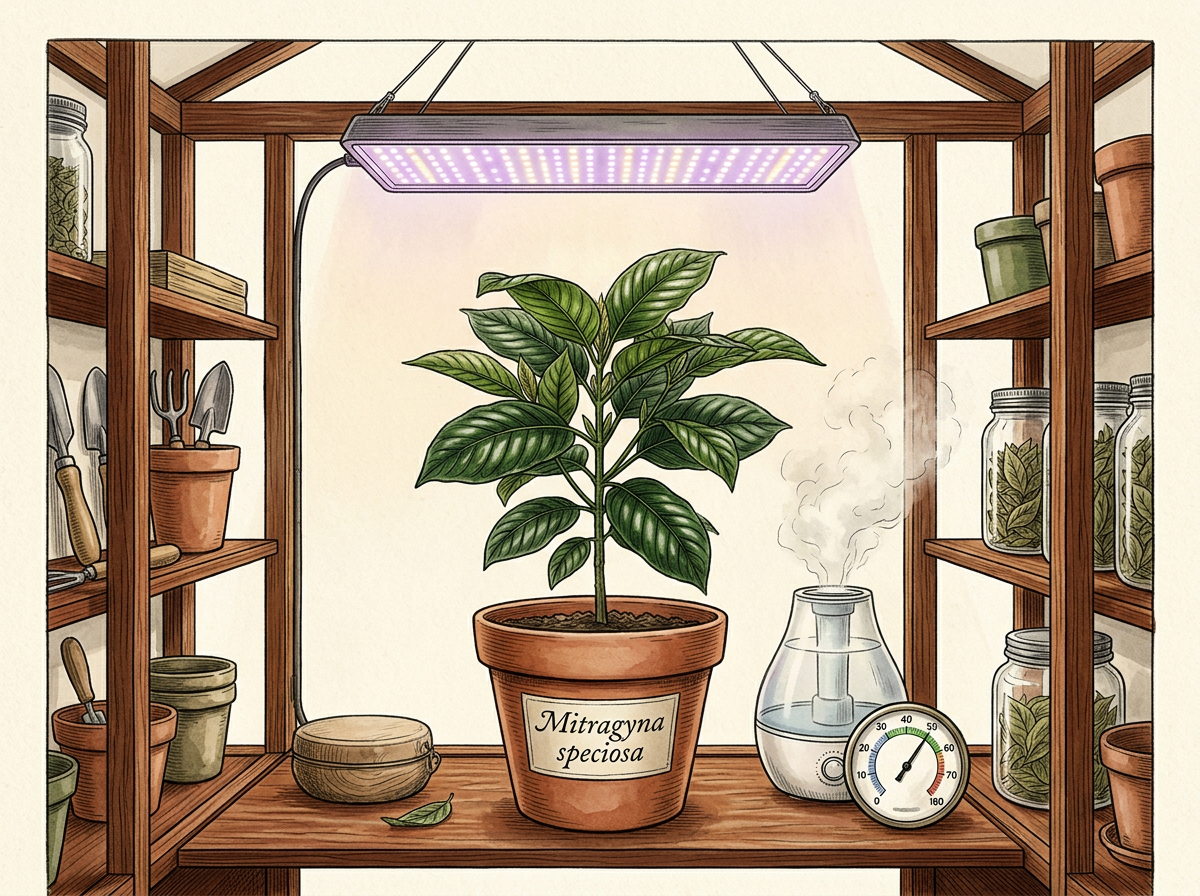
The supplies that matter most for kratom are the ones that recreate a tropical environment: a quality full-spectrum LED grow light with a timer, a humidifier or humidity tray, a rich and well-draining potting mix, a container with drainage, and a thermometer-hygrometer. Useful extras include a soil pH meter, a heat mat for seeds and cuttings, and pruning shears. All-in-one grow kits can be convenient, but buying the key pieces separately usually gives a better fit.
Key Facts
| Most important | Grow light + timer, humidity control, warmth |
|---|---|
| Soil | Rich, well-draining, slightly acidic mix |
| Monitoring | Thermometer-hygrometer; optional pH meter |
| Propagation | Humidity dome, heat mat, rooting hormone |
| Upkeep | Pruning shears, fertilizer, pest controls |
| Review method | Category guidance from extension sources and grower experience |
Most grow kratom reviews (opens in a new tab) online focus on individual gadgets, but the real question for a new grower is which categories of supplies make a difference. Kratom (Mitragyna speciosa) is a tropical tree, so the equipment that matters most is whatever helps recreate warm, humid, brightly lit conditions. This review goes category by category, explaining what to look for and what to skip. It is based on university extension guidance and common grower experience rather than hands-on testing of specific brands, and it contains no prices or star ratings.
How this review works
Rather than ranking branded products, each section explains the features that matter for kratom specifically and gives a plain verdict on how necessary the category is. Links go to Amazon search results so readers can compare current options themselves. For a single shopping page organized by category, see the grow supplies page.
1. Grow lights
Verdict: essential indoors. Light is the most common limiting factor for indoor kratom. A full-spectrum LED fixture is efficient and runs cooler than older lighting. What to look for:
- Full-spectrum white light suitable for leafy growth
- A coverage area that matches the plant (a small panel for seedlings, a larger fixture for a tree)
- Adjustable height or hanging hardware
- A built-in timer or compatibility with an outlet timer
Skip novelty lights that give no coverage information. The light hours guide explains schedules by stage.
2. Humidifiers and humidity trays
Verdict: essential for seedlings and cuttings, very helpful for young trees. Kratom prefers high humidity, and dry indoor winter air causes crispy leaf edges. Options range from pebble trays (cheap, modest effect) to room humidifiers (stronger, need regular cleaning) to small grow tents (best control). Look for an easy-to-clean tank and, ideally, a built-in humidistat. See watering and humidity for kratom.
3. Thermometer-hygrometer
Verdict: essential and inexpensive. A digital thermometer-hygrometer shows whether temperature and humidity are actually in range. Models with min/max memory reveal overnight cold dips that are easy to miss.
4. Potting mix and amendments
Verdict: essential. Kratom wants rich soil that holds moisture but drains freely. A quality potting mix amended with perlite and organic matter works well. Avoid dense garden soil in containers. The soil and pH guide covers mixes and pH.
5. Pots and containers
Verdict: essential; choose drainage over looks. Any pot must have drainage holes. Fabric pots encourage healthy roots and dry evenly; plastic pots hold moisture longer; heavy ceramic pots add stability for tall trees. Size up gradually rather than jumping to a huge container. See repotting and pruning kratom.
6. Soil pH meter
Verdict: useful, not mandatory. Inexpensive probe meters are rough indicators; slurry tests or a soil test through a local extension office are more accurate. Clemson Extension notes that soil pH can be lowered with sulfur, so knowing the starting point helps.
7. Propagation gear
Verdict: worth it if starting from seeds or cuttings. A humidity dome, seedling heat mat and rooting hormone make propagation more reliable. A 2025 study found rooting hormones increased root number in kratom cuttings, although they were not required for rooting success. See how to clone kratom from cuttings.
8. Fertilizer
Verdict: needed for steady growth. Kratom is a leafy plant and responds to adequate nitrogen. A balanced or nitrogen-leaning liquid fertilizer applied lightly during active growth is a simple approach, and University of Florida researchers have studied how nutrient levels affect kratom growth. See how to fertilize kratom.
9. Pest control basics
Verdict: keep on hand. Indoor kratom can attract spider mites, aphids and scale. UC IPM lists insecticidal soap and horticultural oils among lower-impact options for these pests. See kratom pests and diseases.
10. All-in-one grow kits
Verdict: convenient for beginners, but check what is included. A plant grow kit (opens in a new tab) can bundle a light, tray and dome. Many kits are designed for small herbs and seedlings, which suits kratom's early stages but not a growing tree. Check light coverage, whether the light height adjusts, and whether a humidity dome is included.
A sensible starter list
- A healthy kratom plant or rooted cutting (where legal)
- A full-spectrum LED grow light and outlet timer
- A humidifier or humidity tray
- A digital thermometer-hygrometer
- Rich, well-draining potting mix with perlite
- A pot with drainage holes, slightly larger than the root ball
- A liquid fertilizer for leafy plants
What to skip
- Gadgets that promise to speed growth dramatically
- Moisture meters treated as exact science (use them as rough guides)
- Oversized pots for small plants, which stay wet and invite root problems
Before buying any supplies, confirm kratom is legal where you live by reading is it legal to grow kratom in the US. Then follow the complete grow guide.
Frequently Asked Questions
What is the most important supply for growing kratom indoors?
A good full-spectrum LED grow light on a timer, followed closely by humidity control and steady warmth.
Are kratom grow kits worth it?
They can be convenient for seedlings and cuttings, but most kits are designed for small plants. A growing tree soon needs a larger light and pot.
Does this review test specific products?
No. It reviews categories of supplies using university extension guidance and common grower experience, and it does not include prices or star ratings.
Sources
- Lighting for indoor plants (opens in a new tab) — University of Minnesota Extension
- Changing the pH of Your Soil (HGIC 1650) (opens in a new tab) — Clemson Cooperative Extension, Home & Garden Information Center
- UC IPM Pest Notes (Spider Mites 7405, Aphids 7404, Scales 7408) (opens in a new tab) — University of California Statewide Integrated Pest Management Program
- Aeroponics enables consistent cutting propagation of kratom (Mitragyna speciosa): impacts of photoperiod, cultivar, and rooting hormone (2025) (opens in a new tab) — Frontiers in Plant Science
- Effects of Nutrient Fertility on Growth and Alkaloidal Content in Mitragyna speciosa (Kratom) — Zhang et al., Frontiers in Plant Science 11:597696 (2020) (opens in a new tab) — Frontiers in Plant Science (University of Florida researchers)
- Common grower experience (not a formal study) — Practices widely reported by hobby and nursery growers; treat as practical guidance rather than research findings
Written and reviewed by the Editorial Team. See editorial standards.
Related Guides
All guidesHow to Grow Kratom Indoors: Light, Humidity and Space Setup
Yes — with a full-spectrum LED, a humidifier, steady 70–85°F warmth and gentle airflow.
Read guideBest Soil and pH for Kratom: Potting Mixes That Keep Roots Happy
A rich, well-draining potting mix with plenty of organic matter and perlite, kept slightly acidic at roughly pH 5.5–6.5.
Read guideHow Many Hours of Light Does Kratom Need? Light Schedules by Stage
About 12–16 hours of light a day indoors, with a consistent dark period; cuttings root better at 14 hours than at 10.
Read guide