Mature Trees & Harvest
How Big Do Kratom Trees Grow? Wild, Outdoor and Container Sizes
Editorial Team Last updated
This page contains affiliate links. If you buy through them, the site may earn a commission at no extra cost to you.
Quick Answer
In their native tropical forests, kratom trees commonly grow well beyond 15 meters (about 50 feet), with some references describing trees up to around 25 meters. In-ground trees in USDA zones 10–11 can become large garden trees, while container-grown kratom is usually kept between 4 and 10 feet with pot size and pruning.
Key Facts
| Wild height | Often 15 m+ (50 ft+); some references cite up to ~25 m |
|---|---|
| In-ground (warm US zones) | Large garden tree within several years |
| Container (typical) | 4–10 ft with pruning |
| Final pot size | Commonly 15–25 gallons |
| Leaf length | Large; often hand-length on healthy trees |
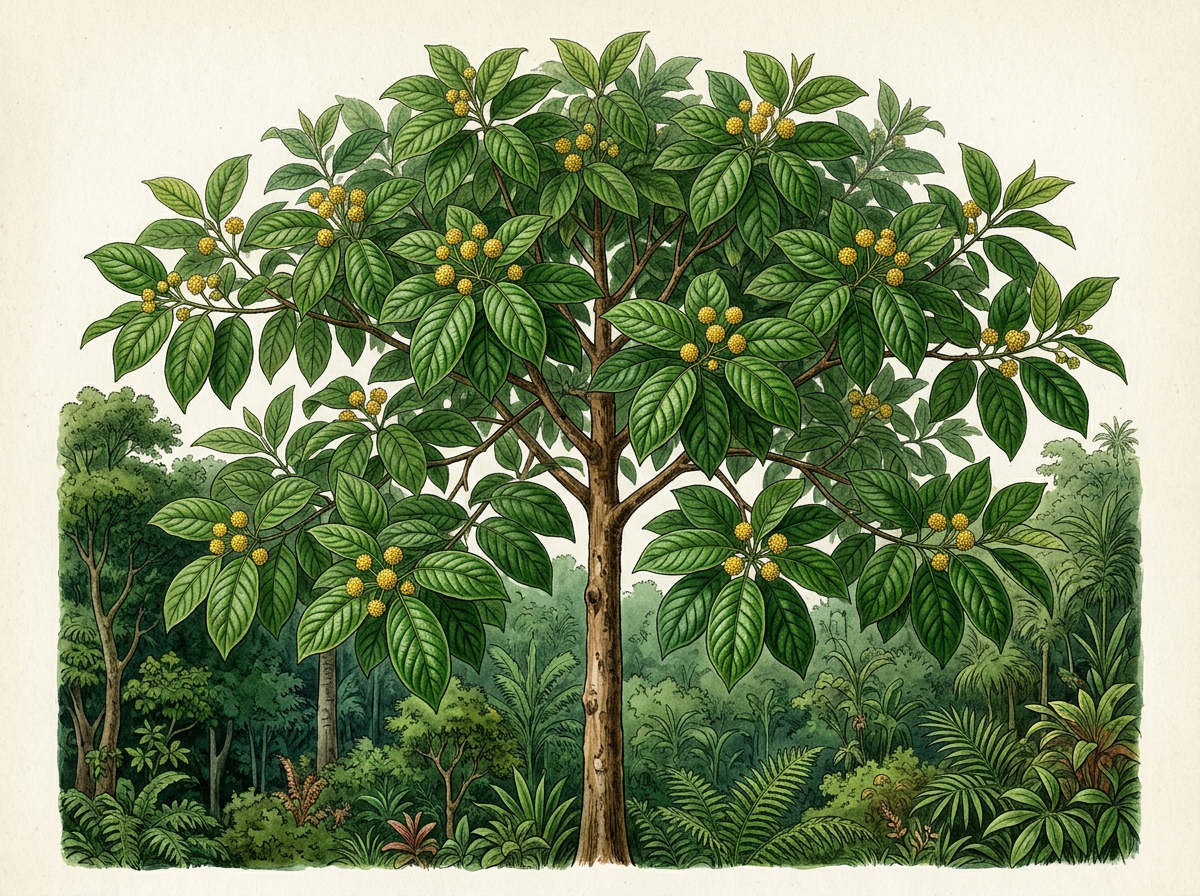
How big do kratom trees grow (opens in a new tab)? It depends almost entirely on where they are planted. In the wet tropical forests of Southeast Asia, kratom is a true forest tree that can grow beyond 15 meters (roughly 50 feet), and botanical references describe exceptional specimens reaching around 25 meters. In a home garden in a warm climate it becomes a substantial tree, and in a container it can be kept to the height of a person with pruning.
Size in the wild
Kratom is native to a region stretching from southern Indo-China to New Guinea, according to Kew's Plants of the World Online. There it grows in humid lowland forests, frequently along rivers and on seasonally flooded ground. With year-round warmth, abundant rain and rich soil, wild trees develop tall, straight trunks and broad canopies and continue growing for many years. Brown, Lund and Murch's 2017 botanical review of the genus describes Mitragyna species as trees of substantial size.
Size when planted in the ground outside Asia
In frost-free areas — roughly USDA hardiness zones 10–11, which include parts of South Florida, Hawaii, Puerto Rico and coastal Southern California — kratom can be planted in the ground where local law allows. Under these conditions growers report rapid growth, often several feet per year once established. Within a few years an in-ground tree can tower over a single-story house if not pruned. Check the kratom grow zone guide to see whether your area qualifies.
Hawaii and South Florida offer the closest match to native conditions. In drier frost-free areas such as Southern California, trees tend to grow more slowly and need more irrigation and shelter from dry winds.
Size in containers
Most growers outside the tropics keep kratom in containers so it can come indoors in winter. Container size limits root volume, which in turn limits canopy size. Combined with pruning, this keeps trees in a manageable range.
- Year one: about 1–2 feet in a 1–3 gallon pot.
- Year two: about 3–5 feet in a 5–7 gallon pot.
- Year three and beyond: about 5–10 feet in a 10–25 gallon pot, kept in check by pruning.
These ranges reflect common grower experience under good conditions; trees grown with weaker light or lower humidity will be smaller.
How to control the size of a kratom tree
- Choose the final pot size deliberately. A 15–25 gallon fabric pot is a common maximum for indoor growers. Larger pots allow more growth but become very heavy to move.
- Prune the leader. Cutting the main growing tip stops upward growth and encourages side branches. Repeat as needed when new leaders form.
- Root-prune when necessary. For very old container trees, trimming the outer roots during repotting and returning the tree to the same pot can maintain size. This is advanced and stressful for the tree, so do it in warm months only.
- Moderate feeding (carefully). Slightly reduced fertilizer slows growth, but never starve the tree — it will lose vigor and become prone to pests.
The guide to repotting and pruning kratom explains these techniques step by step.
Width and canopy spread
Unpruned container trees tend to grow narrow and tall. Pruned trees develop a rounded canopy roughly as wide as they are tall. Large leaves mean that even a modest tree takes up visual space, so plan for at least a few feet of width around a mature container tree.
Planning space for a growing tree
- Indoor ceilings: Most homes have 8–9 foot ceilings. Prune before the tree reaches the light fixture or ceiling.
- Grow tents: Standard tents are 5–7 feet tall. Account for the pot height and the space needed between canopy and light.
- Doorways: A container tree may need to move indoors and outdoors seasonally; tall trees may not fit through doors.
- Weight: A 25-gallon pot of moist soil is very heavy. Plant caddies with wheels make seasonal moves practical.
How growth rate relates to size
Kratom grows fastest with strong but filtered light, steady warmth, high humidity and ample nutrition. A University of Florida trial published in PLoS ONE found that greenhouse-grown plants were roughly twice as tall as those grown in open field sun over the same period. The growth timeline covers year-by-year expectations, and the stage guide shows how the tree changes visually.
The takeaway
Kratom is genetically a large tree, but growers have plenty of control over its final size. In a container with sensible pruning, it fits comfortably in a home. In the ground in the tropics, give it room — it will use it.
Frequently Asked Questions
How tall does kratom grow indoors?
Indoor container trees are typically kept between about 4 and 10 feet by limiting pot size and pruning the growing tip. Without pruning they keep growing until they reach the ceiling.
How fast do kratom trees grow?
In warm, humid, bright conditions an established tree can add several feet per year. Growth is much slower in cool or dry conditions.
Can I keep a kratom tree small?
Yes. Regular pruning of the leader and side branches, combined with a fixed final pot size, keeps kratom compact for many years.
Sources
- Mitragyna speciosa Korth. — Plants of the World Online (opens in a new tab) — Royal Botanic Gardens, Kew
- A botanical, phytochemical and ethnomedicinal review of the genus Mitragyna Korth: Implications for products sold as kratom — Brown, Lund & Murch (2017) (opens in a new tab) — Journal of Ethnopharmacology 202:302–325 (PubMed record)
- Plant growth and phytoactive alkaloid synthesis in kratom [Mitragyna speciosa (Korth.)] in response to varying radiance — Zhang et al., PLoS ONE 17(4): e0259326 (2022) (opens in a new tab) — PLoS ONE
- USDA Plant Hardiness Zone Map (opens in a new tab) — USDA Agricultural Research Service
- Common grower experience (not a formal study) — Practices widely reported by hobby and nursery growers; treat as practical guidance rather than research findings
Written and reviewed by the Editorial Team. See editorial standards.
Related Guides
All guidesRepotting and Pruning Kratom: Keeping a Tall Tree Manageable
Repot one size up every 1–2 years in spring or summer, and prune growing tips just above a leaf pair to keep the tree compact and bushy.
Read guideHow to Grow a Kratom Tree: Container Care From Sapling to Mature Tree
Treat it like a long-term tropical tree: roomy pots, rich acidic soil, warmth, humidity and gradual pruning.
Read guideKratom Grow Zone: Where Can You Grow Kratom Outdoors?
USDA zones 10–11 year-round; zone 9 with frost protection; containers everywhere else.
Read guide