Getting Started
How to Grow a Kratom Tree: Container Care From Sapling to Mature Tree
Editorial Team Last updated
This page contains affiliate links. If you buy through them, the site may earn a commission at no extra cost to you.
Quick Answer
Learning how to grow a kratom tree mostly comes down to stable tropical conditions over several years: a draining container sized up gradually, rich slightly acidic soil, temperatures above 65°F, 60–80% humidity, bright filtered light and regular feeding during warm months, plus pruning to keep the tree manageable.
Key Facts
| Growth habit | Evergreen tree; can exceed 15 m (about 50 ft) in the wild |
|---|---|
| Container size path | 1 gal → 3 gal → 7 gal → 15–25 gal over several years |
| Temperature | 70–90°F (21–32°C) ideal |
| Humidity | 60–80% |
| Soil | Rich, airy, pH about 5.5–6.5 |
| Feeding | Balanced or nitrogen-leaning fertilizer in spring and summer |
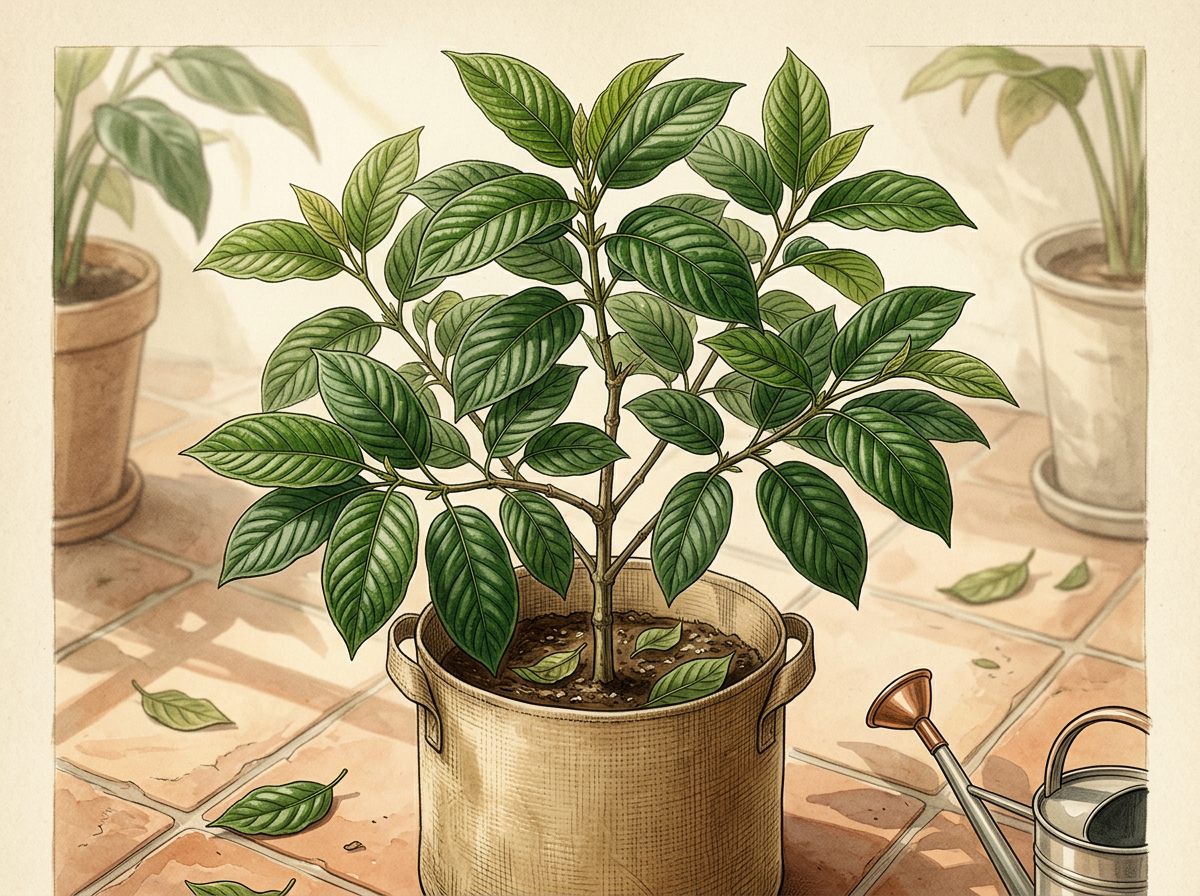
Anyone researching how to grow kratom tree (opens in a new tab) specimens at home should start by picturing the end result: a fast-growing tropical evergreen with glossy, oval leaves that can be as long as a hand and, in its native forests, a trunk that climbs well above a two-story house. Growing one in a container means managing that vigor for years while copying the warm, humid riverbank habitat where the species evolved.
This guide focuses on the tree itself — its structure, root system and long-term container care. For the broader seed-to-harvest overview, start with the complete guide to growing kratom.
Understand what kind of tree kratom is
Mitragyna speciosa belongs to the coffee family (Rubiaceae). Kew's Plants of the World Online records its native range across Thailand, Cambodia, Malaysia, Sumatra, Borneo, the Philippines and New Guinea, primarily in wet tropical biomes. The tree has opposite leaves, a straight trunk when unpruned, and round, yellow flower clusters on mature specimens.
Three traits matter most for growers:
- It is evergreen. Kratom has no dormant season. Leaf drop usually signals stress such as cold, drought or root problems.
- It is fast and thirsty. Large leaves transpire heavily, so water use rises quickly as the canopy grows.
- It wants to be big. Without pruning or container restriction, the tree keeps reaching upward. See how big kratom trees grow for realistic indoor and outdoor sizes.
Choose the right container
Root health decides tree health. Kratom roots need a steady supply of both water and oxygen, so the container must drain freely.
- Start small. A rooted cutting or young seedling belongs in a 1-gallon pot. A huge pot holds water the roots cannot reach, and the soil stays soggy.
- Move up one size at a time. When roots circle the inside of the pot or poke from drainage holes, step up to the next size, usually every 6–12 months while young.
- Consider fabric pots. Breathable fabric pots air-prune roots and reduce the risk of waterlogging. Many growers use them for every stage.
- Plan the final size. Most indoor growers stop at 15–25 gallons and control size from then on with pruning.
Build a tropical soil mix
Kratom grows naturally on fertile, moisture-retentive alluvial soils near rivers. A container blend should copy that richness while staying airy. A good starting point is roughly 50% quality tropical potting soil, 25% perlite and 25% fine composted bark. Keep the pH slightly acidic, around 5.5 to 6.5. The soil and pH guide explains how to test and adjust it.
Provide light without scorching
Young trees appreciate bright but filtered light. A University of Florida study published in PLoS ONE in 2022 found that kratom grown in a shaded greenhouse had substantially larger leaves and more total leaf mass than plants grown in open field sun. Indoors, place the tree near a bright window or under a full-spectrum LED. Outdoors, partial afternoon shade protects tender leaves, especially in hot, dry regions.
Keep temperature and humidity steady
Kratom tolerates heat well as long as the air is humid and the soil is moist. Cold is the bigger danger: growth stalls in the low 60s°F, and many growers report leaf damage near 50°F (10°C). Humidity between 60% and 80% keeps leaves supple and helps discourage spider mites. Details are in the watering and humidity guide.
Feed a hungry tree
As a leafy plant, kratom uses a lot of nitrogen. Research on container-grown kratom at the University of Florida found that increasing fertilizer rates increased growth, and that leaf chlorophyll readings could help diagnose nutrient shortfalls. A balanced or nitrogen-leaning fertilizer applied regularly during spring and summer is a sensible baseline; scale back in winter when growth slows. The fertilizer guide gives a month-by-month plan.
Train and prune for a manageable shape
Left alone, a container kratom tree tends to grow as a single tall stem. Pinching or cutting the growing tip encourages side branches, producing a fuller, shorter tree that fits under a ceiling or grow light. Pruning is best done during active growth so the tree recovers quickly, and the cuttings removed can be rooted to make new plants. See repotting and pruning kratom.
A year in the life of a container tree
- Spring: Repot if root-bound, resume regular feeding, prune for shape, and begin hardening off for outdoor time once nights stay above 60°F.
- Summer: Peak growth. Water often, feed regularly, watch for spider mites in dry spells.
- Autumn: Bring the tree indoors before nights cool. Inspect carefully for hitchhiking pests.
- Winter: Bright light, steady warmth, reduced feeding, and careful watering so soil never stays soggy.
Signs the tree is thriving
A healthy kratom tree shows large, glossy, deep-green leaves, steady new growth at branch tips, and firm stems. Pale or yellowing older leaves often point to a nitrogen shortfall, brown crispy edges suggest low humidity or underwatering, and sudden drooping with wet soil can indicate root rot.
Growing a kratom tree is a multi-year commitment, but the work itself is straightforward. Get the pot, soil and climate right, and the tree will do most of the rest.
Frequently Asked Questions
What size pot does a kratom tree need?
Start rooted cuttings in about a 1-gallon pot and step up one size at a time as roots fill the container. Many indoor growers settle at 15–25 gallons and manage height with pruning.
Can a kratom tree live indoors permanently?
Yes, with strong light, warmth and 60–80% humidity. A full-spectrum LED and a humidifier make permanent indoor growing practical, though summers outdoors often boost vigor where the climate allows.
Why is my kratom tree dropping leaves?
The most common causes are cold temperatures, dry air, soil that dried out completely, or root rot from soggy soil. Check night temperatures and soil moisture first.
Sources
- Mitragyna speciosa Korth. — Plants of the World Online (opens in a new tab) — Royal Botanic Gardens, Kew
- A botanical, phytochemical and ethnomedicinal review of the genus Mitragyna Korth: Implications for products sold as kratom — Brown, Lund & Murch (2017) (opens in a new tab) — Journal of Ethnopharmacology 202:302–325 (PubMed record)
- Plant growth and phytoactive alkaloid synthesis in kratom [Mitragyna speciosa (Korth.)] in response to varying radiance — Zhang et al., PLoS ONE 17(4): e0259326 (2022) (opens in a new tab) — PLoS ONE
- Effects of Nutrient Fertility on Growth and Alkaloidal Content in Mitragyna speciosa (Kratom) — Zhang et al., Frontiers in Plant Science 11:597696 (2020) (opens in a new tab) — Frontiers in Plant Science (University of Florida researchers)
- Common grower experience (not a formal study) — Practices widely reported by hobby and nursery growers; treat as practical guidance rather than research findings
Written and reviewed by the Editorial Team. See editorial standards.
Related Guides
All guidesHow Big Do Kratom Trees Grow? Wild, Outdoor and Container Sizes
Wild trees can exceed 15 m (about 50 ft); container trees are usually kept at 4–10 ft.
Read guideRepotting and Pruning Kratom: Keeping a Tall Tree Manageable
Repot one size up every 1–2 years in spring or summer, and prune growing tips just above a leaf pair to keep the tree compact and bushy.
Read guideBest Soil and pH for Kratom: Potting Mixes That Keep Roots Happy
A rich, well-draining potting mix with plenty of organic matter and perlite, kept slightly acidic at roughly pH 5.5–6.5.
Read guide