Legal & Origins
What Is Green Borneo Kratom? The Name, the Leaf and the Tree Explained
Editorial Team Last updated
This page contains affiliate links. If you buy through them, the site may earn a commission at no extra cost to you.
Quick Answer
Green Borneo kratom is a market name, not a separate plant. It refers to leaf from Mitragyna speciosa that is associated with the island of Borneo and sold under the “green vein” label. Botanically, all kratom is the same species; the color names relate to the color of the leaf's central vein and stems, and are also shaped by when leaves are picked and how they are dried.
Key Facts
| Species | Mitragyna speciosa (same as all kratom) |
|---|---|
| “Green” refers to | Leaf vein/stem color category used in the trade |
| “Borneo” refers to | The island where the leaf is said to originate |
| Borneo's countries | Indonesia (Kalimantan), Malaysia (Sabah, Sarawak), Brunei |
| Main growing area | West Kalimantan, Indonesia |
| Grow it at home? | Yes — any kratom tree; labels apply to leaf, not seeds |
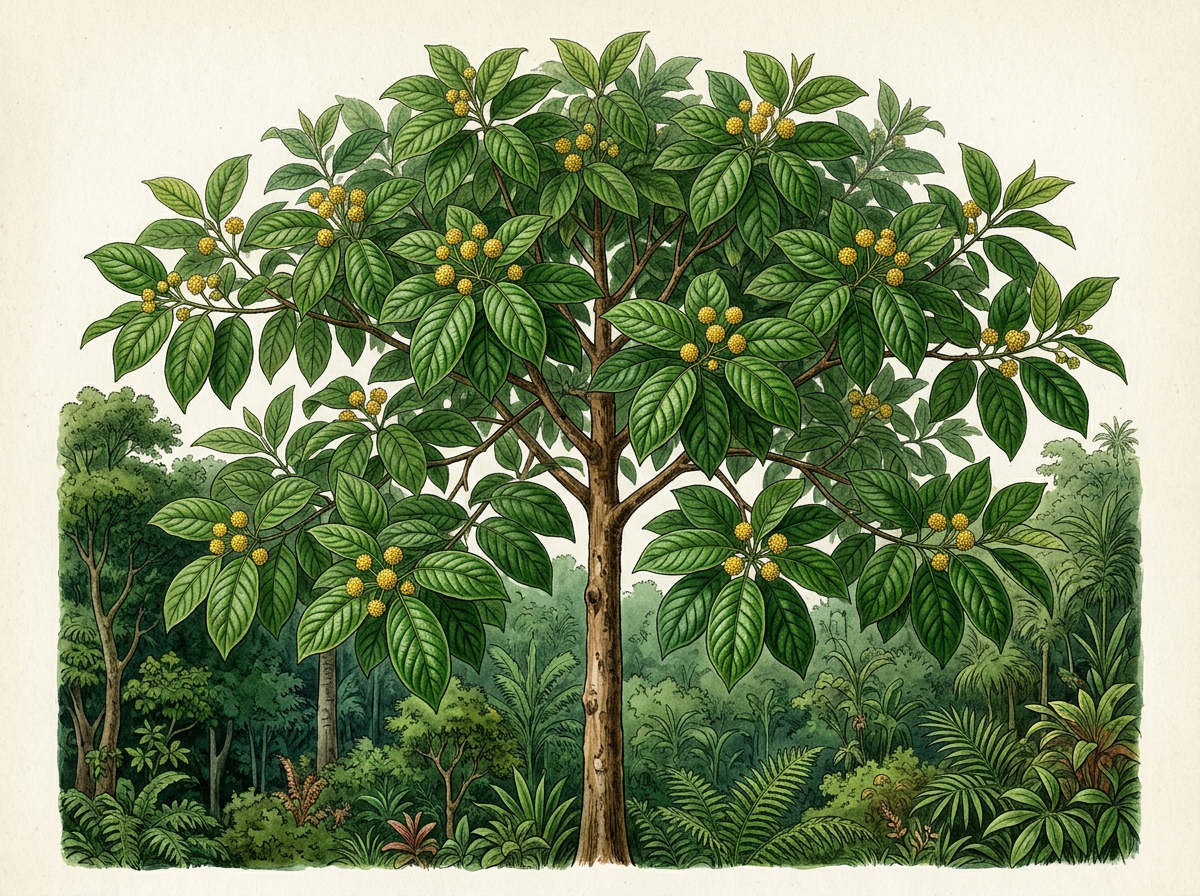
What is green Borneo kratom (opens in a new tab)? It is a trade name that combines two ideas: a place (Borneo, the large island shared by Indonesia, Malaysia and Brunei) and a color category (green, describing the leaf's vein and stem color). It is not a distinct species or registered plant variety. Every product sold under that name comes from the same tree, Mitragyna speciosa, that grows across Southeast Asia. This guide explains what the label means botanically and what it means for anyone growing a kratom tree.
The “Borneo” part of the name
Borneo is the third-largest island in the world and lies at the center of kratom's native range. The species was first described by the Dutch botanist Pieter Korthals in 1839 from specimens collected on Borneo. Today, the Indonesian province of West Kalimantan on Borneo is one of the most important kratom-growing areas in the world, with smallholder farms in districts such as Kapuas Hulu and Melawi.
Because so much kratom comes from Indonesian Borneo, “Borneo” on a label is a broad regional name. It does not identify a specific farm, district or genetic line, and buyers usually cannot verify it independently. The guide to where they grow kratom covers Borneo's farming regions in more detail.
The “green” part of the name
Kratom leaves have a prominent central vein (the midrib) and a network of side veins. In the trade, leaf is commonly sorted into three color groups — red, green and white — based on the color of these veins and the leaf stems. On a living tree, vein color can vary between leaves, between trees, and as leaves age.
Vendors and growers commonly describe these color categories as reflecting a mix of factors:
- Natural variation: Some trees and leaves show reddish veins, others green or pale veins.
- Leaf age: Younger and older leaves can differ in color.
- Harvest timing: When leaves are picked is often said to influence the category.
- Drying and processing: Drying methods, light exposure and fermentation steps can change how dried leaf looks.
There is limited formal research on how these trade categories map to plant biology, so the color names are best understood as market conventions rather than botanical classifications.
Green Borneo vs. other Borneo labels
Borneo appears with all three colors in the market. For comparison, Sacred Plant Life covers the other two in its white Borneo kratom guide (opens in a new tab) and its red Borneo kratom guide (opens in a new tab). All three come from the same species, and the main differences claimed by sellers relate to vein color, harvest timing and processing.
Is green Borneo kratom a different plant?
No. Kew's Plants of the World Online recognizes a single species, Mitragyna speciosa, with no formally named botanical varieties for vein colors. Research does show that kratom trees naturally vary: a 2022 survey of naturally growing populations in Thailand found differences between trees in different regions and environments. That variation is real, but it does not line up neatly with the red, green and white trade names.
Can you grow green Borneo kratom at home?
A home grower can grow a kratom tree, and some nurseries sell plants or cuttings described by origin or vein color. A few practical points:
- Labels describe leaf, not guaranteed genetics. A cutting sold as “green Borneo” is a kratom plant whose parent was given that name; the label itself is not a verified variety.
- Vein color can change. Growing conditions, leaf age and light can all influence how veins look on your tree.
- Cuttings preserve the parent plant. If a grower likes a particular tree, cloning it is the way to reproduce it; see how to clone kratom from cuttings.
- Seed-grown plants vary. Each seedling is genetically unique, so seedlings will not reliably match a label.
The complete grow guide covers every stage, and buying kratom plants and seeds explains how to evaluate nursery listings.
What Borneo's climate tells growers
Borneo is equatorial: hot, humid and wet all year, with no frost. Kratom there grows along rivers and in moist lowland soils. To keep any kratom tree healthy, recreate those conditions as closely as possible — warm temperatures around 75–90°F (24–32°C), humidity of 60–80% for young plants, rich, slightly acidic soil, and bright light. The climate guide explains each factor.
Reading labels with a critical eye
Because both the place name and the color name are hard for buyers to verify, many people look to independent lab testing and clear sourcing information rather than to the name alone. Vendors such as Super Speciosa (opens in a new tab) publish lab reports for their products, which gives buyers something concrete to review.
Frequently Asked Questions
Is green Borneo kratom a separate species?
No. It is a trade name for leaf from Mitragyna speciosa associated with Borneo and the green vein color category. There is only one kratom species.
Why is it called green vein?
The name refers to the color of the leaf's central vein and stems. Sellers also attribute the category to harvest timing and drying methods.
Can I grow a green Borneo kratom tree?
You can grow a kratom tree, and some nurseries sell plants labeled by origin or color. The label is not a verified variety, and vein color can vary with growing conditions.
Sources
- Mitragyna speciosa Korth. — Plants of the World Online (opens in a new tab) — Royal Botanic Gardens, Kew
- Variations in mitragynine content in the naturally growing Kratom (Mitragyna speciosa) population of Thailand — Leksungnoen et al. (2022) (opens in a new tab) — Frontiers in Plant Science 13:1028547
- A botanical, phytochemical and ethnomedicinal review of the genus Mitragyna Korth: Implications for products sold as kratom — Brown, Lund & Murch (2017) (opens in a new tab) — Journal of Ethnopharmacology 202:302–325 (PubMed record)
- Soil properties and heavy-metal levels in kratom production areas of Kapuas Hulu, West Kalimantan (opens in a new tab) — Indian Journal of Agricultural Research (ARCC Journals)
- Common grower experience (not a formal study) — Practices widely reported by hobby and nursery growers; treat as practical guidance rather than research findings
Written and reviewed by the Editorial Team. See editorial standards.
Related Guides
All guidesWhere Do They Grow Kratom? Farming Regions and How Cultivation Works
Mostly on smallholder farms in Indonesia, especially West Kalimantan on Borneo, with smaller production elsewhere in Southeast Asia.
Read guideHow Does Kratom Grow? The Biology of Mitragyna speciosa
As a fast evergreen tree that adds opposite leaf pairs at its tips and flowers in round yellow heads.
Read guideHow to Clone Kratom From Cuttings: Step-by-Step Propagation Guide
Take a healthy stem cutting, trim the leaves, optionally dip in rooting hormone, and keep it warm and very humid with about 14 hours of light until it roots.
Read guide