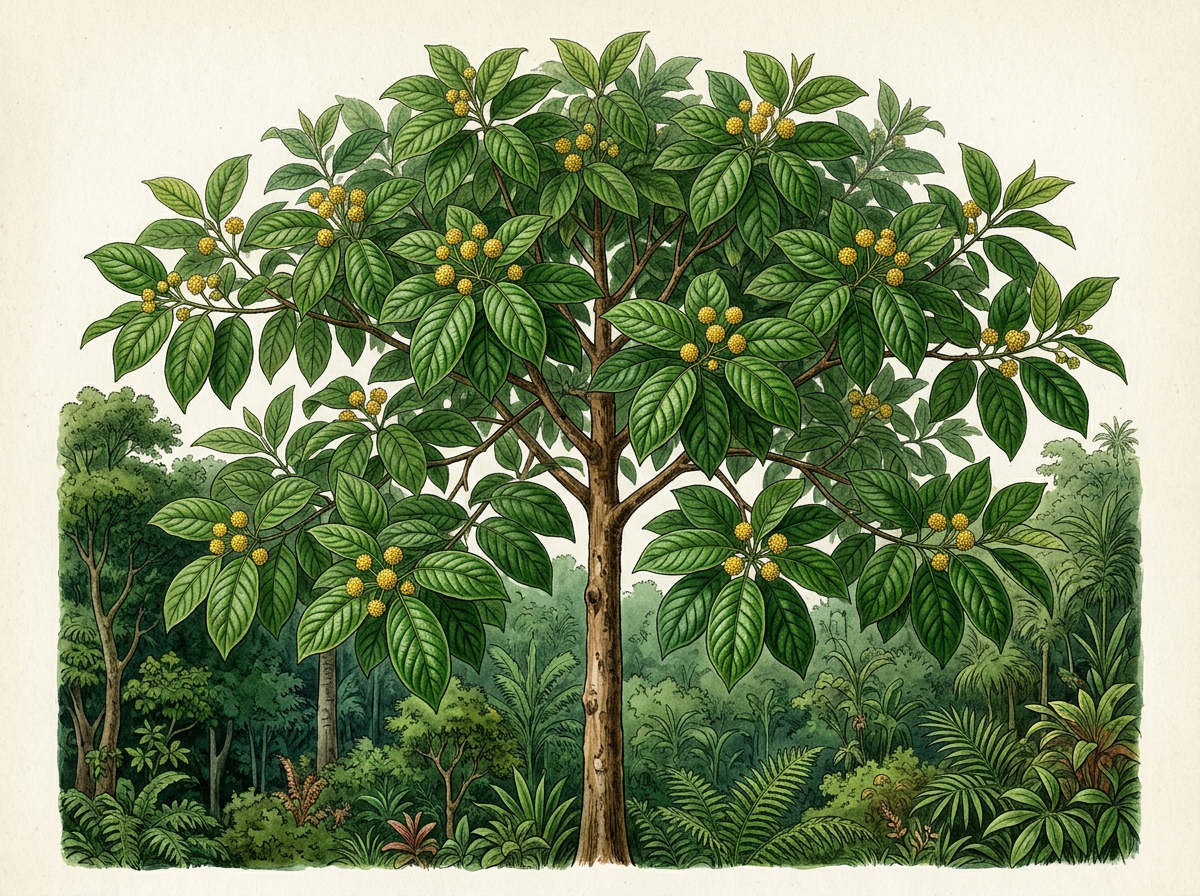
Mature Trees & Harvest
How Does Kratom Grow? The Biology of Mitragyna speciosa
Editorial Team Last updated
This page contains affiliate links. If you buy through them, the site may earn a commission at no extra cost to you.
Quick Answer
Kratom grows as a fast, evergreen tropical tree. New growth emerges at stem tips as opposite pairs of large oval leaves, the trunk thickens and branches over time, and mature trees produce round, yellow flower heads that form tiny wind-dispersed seeds. Growth is continuous when warm and humid, with no dormant season.
Key Facts
| Family | Rubiaceae (coffee family) |
|---|---|
| Leaf arrangement | Opposite pairs, large oval leaves |
| Habit | Evergreen tree, no true dormancy |
| Flowers | Globular yellow flower heads on mature trees |
| Seeds | Tiny, winged, short-lived |
| Native habitat | Wet tropical forests, often near rivers |
How does kratom grow (opens in a new tab) in the wild and in a pot? Mitragyna speciosa is an evergreen tree in the coffee family that grows continuously whenever conditions are warm and humid. New leaves emerge in opposite pairs at the tips of stems, the main stem thickens into a woody trunk, and mature trees produce round flower heads that release tiny seeds. Understanding this growth pattern makes every care decision easier.
Botanical background
Kratom was formally described by the Dutch botanist Pieter Korthals in 1839, based on specimens from Borneo. Kew's Plants of the World Online places it in the Rubiaceae, the same family as coffee and gardenia, and records its native range from southern Indo-China through Malesia to New Guinea. USDA GRIN Taxonomy records the same family placement and notes cultivation in Vietnam.
How kratom leaves grow
Kratom produces leaves in opposite pairs: two leaves emerge from the same point on the stem, facing each other. Each new pair grows at roughly a right angle to the pair below, a pattern botanists call decussate. Leaves are broad, glossy and oval with a pointed tip, and on healthy trees can be as long as a hand.
New leaves start small, soft and light green at the stem tips, then expand and darken over several weeks. Older leaves lower on the stem eventually yellow and drop as the tree redirects resources to new growth — a normal process as long as new growth keeps pace.
Leaf veins and color
Kratom leaves have a prominent central vein and side veins. In the trade, products are often labeled by “vein color” — red, green or white. From a horticultural perspective, these labels are market naming conventions rather than separate species, and growers notice that veins on a single tree can vary in color with leaf age and light exposure. For a breakdown of how the trade uses these terms, see this explainer on red, green and white vein kratom (opens in a new tab). The green Borneo guide covers how regional names fit in.
How the tree structure develops
Young kratom plants typically grow as a single upright stem. The growing tip (apical bud) suppresses side shoots, so a young tree tends to grow tall before it grows wide. When the tip is pinched or cut, buds lower on the stem activate and produce branches. This is why pruning creates bushier container trees. See repotting and pruning kratom.
Over the years, the stem becomes a woody trunk and the canopy spreads. In native forests, trees can reach the height of mature hardwoods; see how big kratom trees grow.
How kratom roots grow
Kratom naturally grows on moist, fertile, often alluvial soils near rivers and in seasonally wet areas. Its roots are adapted to plentiful water but still need oxygen. In containers, this means the soil should stay evenly moist yet drain well. Waterlogged soil quickly leads to root rot, while dry soil causes rapid leaf droop.
How kratom flowers and seeds
Mature trees produce distinctive spherical flower heads, each made of many small yellow flowers packed into a ball. After pollination, these heads develop into seed capsules containing numerous tiny winged seeds that disperse on the wind. Container trees indoors rarely flower, and when they do, it is usually after several years.
Kratom seeds are short-lived. Propagation researchers describe low seed viability as a key reason cuttings are the dominant propagation method. See how to grow kratom from seed.
How environment shapes growth
- Light: A 2022 University of Florida study found that shaded greenhouse kratom grew taller and wider, with larger leaves, than trees in open field sun.
- Nutrients: A 2020 University of Florida study found that higher fertilizer rates increased plant growth.
- Climate: A 2022 survey of naturally growing kratom in Thailand identified light intensity, relative humidity, soil moisture, soil pH and calcium as influential environmental factors.
- Temperature: Growth slows sharply in cool conditions and stops near frost.
Growth rate
In warm, humid, bright conditions, kratom is a fast grower and can add several feet per year once established. In containers and cooler climates, growth is slower and seasonal. The growing timeline breaks down what to expect year by year.
Putting biology into practice
Knowing how kratom grows explains the standard care advice: keep it warm because it has no dormancy, keep humidity high because its big leaves lose water fast, keep soil moist but airy because its roots are adapted to wet but oxygenated riverbanks, and prune the tip to control height. For a full care plan, start with the complete grow guide.
Frequently Asked Questions
Does kratom lose its leaves in winter?
Kratom is evergreen and has no natural dormancy. Leaf drop in winter usually signals stress from cold, dry air, low light or watering problems.
Do kratom trees flower?
Yes. Mature trees produce round, yellow, ball-shaped flower heads that later form seed capsules. Indoor container trees rarely flower.
Is kratom a tree or a shrub?
Kratom is a tree. It can be kept shrub-sized in containers by pruning, but left alone it develops a woody trunk and tall canopy.
Sources
- Mitragyna speciosa Korth. — Plants of the World Online (opens in a new tab) — Royal Botanic Gardens, Kew
- Mitragyna speciosa — GRIN-Global Taxonomy (Nomen 417532) (opens in a new tab) — USDA Agricultural Research Service, Germplasm Resources Information Network
- A botanical, phytochemical and ethnomedicinal review of the genus Mitragyna Korth: Implications for products sold as kratom — Brown, Lund & Murch (2017) (opens in a new tab) — Journal of Ethnopharmacology 202:302–325 (PubMed record)
- Plant growth and phytoactive alkaloid synthesis in kratom [Mitragyna speciosa (Korth.)] in response to varying radiance — Zhang et al., PLoS ONE 17(4): e0259326 (2022) (opens in a new tab) — PLoS ONE
- Effects of Nutrient Fertility on Growth and Alkaloidal Content in Mitragyna speciosa (Kratom) — Zhang et al., Frontiers in Plant Science 11:597696 (2020) (opens in a new tab) — Frontiers in Plant Science (University of Florida researchers)
- Variations in mitragynine content in the naturally growing Kratom (Mitragyna speciosa) population of Thailand — Leksungnoen et al. (2022) (opens in a new tab) — Frontiers in Plant Science 13:1028547
- Aeroponics enables consistent cutting propagation of kratom (Mitragyna speciosa): impacts of photoperiod, cultivar, and rooting hormone (2025) (opens in a new tab) — Frontiers in Plant Science
Written and reviewed by the Editorial Team. See editorial standards.
Related Guides
All guidesHow Big Do Kratom Trees Grow? Wild, Outdoor and Container Sizes
Wild trees can exceed 15 m (about 50 ft); container trees are usually kept at 4–10 ft.
Read guideKratom Growth Stages in Pictures: From Seed to Mature Tree
Six visual stages: germination, seedling, rooted cutting, young tree, mature tree and leaf harvest.
Read guideWhere Does Kratom Grow Naturally? Native Range and Wild Habitat
In wet tropical forests from Thailand and Cambodia through Malaysia, Indonesia and the Philippines to New Guinea.
Read guide